

You don’t need skills to start an AI business anymore.
No business degree. No coding knowledge. No experience in marketing, design, or writing. No team, no big budget, no fancy office.
What you need is a laptop, a few AI tools that cost less than your Netflix subscription, and a decision to actually start.
According to Forbes, the number of solo entrepreneurs leveraging AI tools to build profitable online businesses has grown faster in 2025–2026 than any previous wave of digital entrepreneurship. A one person AI business is now one of the most accessible income opportunities that has ever existed — with people generating $1,000–$8,000/month from AI-powered services, content, and digital products.
This guide covers everything: what a one person AI business actually looks like, which models work for complete beginners, and a step-by-step system to go from zero to your first paying client or sale.
No hype. No unrealistic promises. Just a clear, honest starting point.
👉 Start with ChatGPT today — the free plan is enough to test your first AI business model before spending a dollar.
Table of Contents
- One Person AI Business: Quick Answer
- Can You Start an AI Business With No Skills?
- What Is a One-Person AI Business?
- Best One-Person AI Business Ideas in 2026
- How to Start a One-Person AI Business (Step-by-Step)
- AI Tools You Need to Start
- One-Person AI Business Income: What to Expect
- Common Mistakes Beginners Make
- FAQ
One Person AI Business: Quick Answer
A one person AI business is a solo business where you use AI tools to deliver services, sell digital products, or create content — generating income without a team, coding skills, or a large startup budget.
The fastest way to start: pick one of the 7 models in this guide, set up a free ChatGPT account, create your first offer, and launch it within 72 hours. Most focused beginners earn their first income within 14–30 days. This is one of the most practical AI business ideas 2026 has produced for people with zero prior experience.
Can You Start an AI Business With No Skills?
Yes — and 2026 is the easiest year in history to do it.
A one person AI business is built on AI tools doing the work that previously required expertise: writing, design, video production, research, data analysis, and automation. You provide the direction, the client relationships, and the judgment. The AI provides the execution.
Starting an AI business for beginners means: you don’t need technical skills, you don’t need prior business experience, and you don’t need a large following or audience. You need to learn how to use the tools — which takes days, not months — and how to find people who will pay for the results those tools produce.
Most beginners see their first income within 30–60 days of starting. Consistent monthly income typically develops over 3–6 months. This is not instant money. But it’s real money — and the barrier to starting has never been lower.
What Is a One-Person AI Business?

A one person AI business is a business you run alone, powered primarily by AI tools, generating income from services, digital products, or content — without requiring a team, a physical location, or significant startup capital.
According to McKinsey’s research on AI and productivity, AI tools enable individual operators to produce the equivalent output of a 3–5 person team in content, design, analysis, and communications. This is the structural advantage that makes the solo AI business model viable in 2026.
What makes it different from traditional freelancing:
AI does the execution. The tools handle drafting, designing, editing, formatting, research, and automation. You handle strategy, client relationships, and quality control.
Low overhead. Your only costs are AI tool subscriptions ($20–$100/month) and basic business infrastructure. No employees, no inventory, no office.
Scales with assets, not hours. A solo AI business generates income from digital products, content, and automated services that work independently of whether you’re actively working.
Multiple income streams are standard. Most successful operators run 2–3 streams simultaneously — typically one active service stream for immediate cash flow, and one or two passive streams that compound over time.
⚠️ Reality check: This is a real business, not a passive income fantasy. It requires real effort to start and real consistency to grow. What AI changes is the output-to-input ratio — dramatically. You can produce what used to require a team of three, operating as a team of one.
Best One-Person AI Business Ideas in 2026
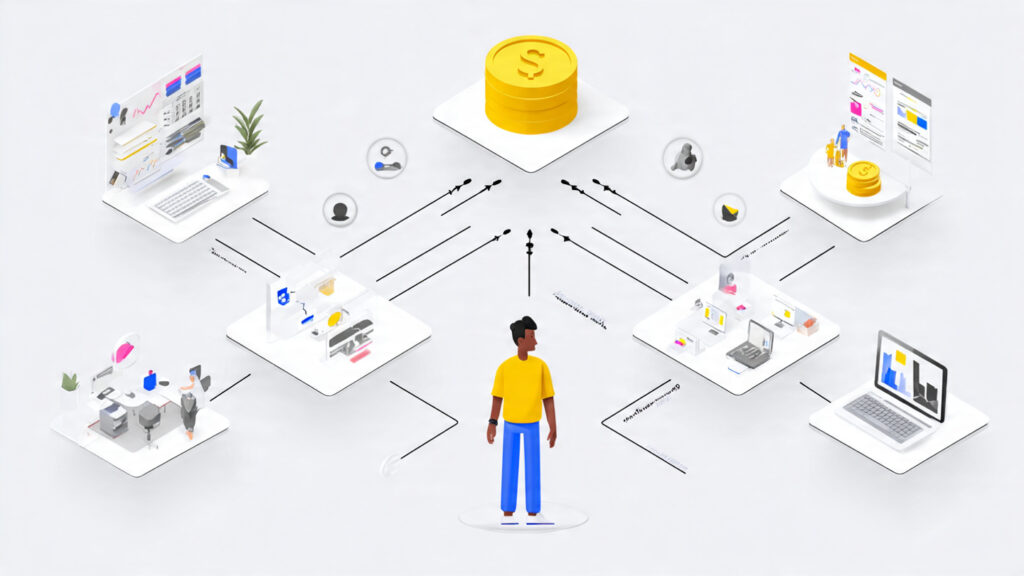
1. AI Content Writing Service
What it is:
You offer professionally edited SEO blog posts, website copy, email newsletters, or social media content to businesses — produced with AI assistance and refined with your editorial judgment.
How it makes money:
Clients pay per article ($75–$300) or on monthly retainers for consistent content production. This is the most beginner-accessible AI freelancing business model because demand is high and the barrier to starting is low.
Tools needed:
- ChatGPT Plus ($20/month) — primary drafting engine
- Claude (free) — alternative for long-form nuance
- Grammarly (free) — quality control
Realistic income: $500–$4,000/month | Time to first client: 7–14 days
💡 Pro tip: Niche immediately. “AI content for SaaS companies” or “AI blog posts for real estate agents” converts at dramatically higher rates than “AI writing services” — and attracts clients willing to pay premium rates.
2. AI Prompt Pack Selling
What it is:
You create and sell collections of carefully engineered AI prompts — ready-to-use instructions for ChatGPT, Midjourney, or Claude — that help buyers get better results from AI tools they’re already paying for.
How it makes money:
List packs on Gumroad, Etsy, or PromptBase at $9–$49. Sell indefinitely with zero fulfillment effort. This is one of the most genuinely passive AI passive income business models available in 2026.
Tools needed:
- ChatGPT (free) — building and testing prompts
- Gumroad (free) — selling digital products
- Canva (free) — product cover design
Realistic income: $200–$2,000/month passive | Time to first sale: 7–14 days
💡 Proven niche examples: “ChatGPT prompts for real estate agents,” “Midjourney prompts for product photography,” “ChatGPT prompts for teachers.” Specificity drives conversion.
See our AI prompts guide for the exact prompt engineering frameworks that make prompt packs genuinely valuable to buyers.
3. AI Automation Services
What it is:
You build AI automation business workflows for small businesses — connecting their existing tools (email, CRM, project management) to eliminate repetitive manual tasks using no-code platforms.
How it makes money:
$500–$3,000 per automation build, plus $200–$600/month ongoing maintenance retainers. This is the highest-earning model on this list for focused operators who commit to learning one automation platform.
Tools needed:
- Zapier (free tier) — no-code automation platform
- Make/Integromat (~$9/month) — more advanced at lower cost
- ChatGPT (free) — workflow ideation and proposal writing
Realistic income: $1,000–$8,000/month | Time to first client: 14–30 days
💡 Entry path: Start by automating one workflow for a local business owner you know — for free, as a case study. Document the result. Use it as proof of concept for paid clients immediately after.
4. Faceless YouTube Channel
What it is:
You create YouTube videos without appearing on camera. AI tools write the scripts, generate visuals, produce voiceover, and handle editing. You manage strategy, publishing, and monetization.
How it makes money:
YouTube AdSense, affiliate links in descriptions, and channel memberships. Multiple income streams from a single content asset that earns indefinitely after publication. This is the most compelling AI online business idea for people who want compound passive income.
Tools needed:
- ChatGPT ($20/month) — script writing
- Pictory AI (~$19/month) — script-to-video conversion
- ElevenLabs (free) — AI voiceover
- Canva (free) — thumbnail design
Realistic income: $500–$8,000+/month (after 4–6 months) | Time to monetization: 4–6 months
⚠️ Reality check: Faceless YouTube requires patience. The first 3–4 months feel slow — you’re below the monetization threshold. Commit to 3+ videos per week and evaluate results at month 5, not month 2. The businesses that succeed do so by staying consistent through the quiet period.
5. AI Affiliate Blog
What it is:
You build an AI business from scratch — a niche content website publishing AI-assisted blog posts targeting commercial-intent keywords with affiliate links to products earning recurring commissions.
How it makes money:
SaaS tools pay 20–50% recurring monthly commissions. One referred customer paying $50/month earns you $10–$25/month indefinitely. Scale to 200 referred customers and that’s $2,000–$5,000/month from a single program.
Tools needed:
- WordPress + domain ($12/year)
- Claude or ChatGPT — article drafting
- Perplexity AI (free) — research and verification
Realistic income: $200–$5,000+/month recurring | Time to first commissions: 60–120 days
For affiliate programs with the best commission structures in 2026, our best AI tools to make money guide covers the highest-paying programs by category.
6. AI Graphic Design Service
What it is:
You offer professional graphic design — logos, brand identity packages, social media graphics, presentations — powered by AI image generation and design tools. No design training required.
How it makes money:
Logo + brand identity packages: $150–$500 per project. Social media retainers: $300–$1,500/month. Presentation design: $100–$400 per deck.
Tools needed:
- Midjourney ($10/month) — concept generation
- Canva Pro ($13/month) — production and client delivery
Realistic income: $500–$5,000/month | Time to first client: 7–21 days
7. AI Social Media Management
What it is:
You manage social media accounts for small businesses — creating content, scheduling posts, growing their presence — with AI handling the majority of production.
How it makes money:
Monthly retainers of $300–$1,500 per client account. Managing 3–5 clients generates $900–$7,500/month. This is one of the most reliable make money with AI business models for beginners because the demand from small businesses is immediate and consistent.
Tools needed:
- ChatGPT or Claude — captions, content ideas
- Canva AI — visual content creation
- Buffer or Metricool (free tiers) — scheduling
Realistic income: $900–$7,500/month (with 3–5 clients) | Time to first client: 7–14 days
For a deeper look at how to position and price these services, explore our guide on AI tools for freelancers — it covers every tool and pricing framework for service-based AI businesses.
How to Start a One-Person AI Business (Step-by-Step)

Step 1 — Choose Your Business Model (Day 1)
Pick one model from the seven above. Not two. Not three. One.
How to choose:
How fast do you need income?
- Fastest (1–2 weeks): Content writing, social media management, graphic design
- Medium (2–4 weeks): Prompt packs, affiliate blog first articles
- Longer (4–6 months): Faceless YouTube — but highest long-term ceiling
What are you comfortable with?
- Comfortable talking to clients → service businesses
- Prefer building alone → digital products and content
What specific problem can you solve?
- “I help real estate agents create consistent social media content”
- “I help SaaS startups produce SEO blog posts at scale”
- “I help e-commerce brands automate their email follow-up sequences”
The more specific your answer, the faster everything else moves.
Step 2 — Set Up Your Minimum Viable Stack (Day 2–3)
For service businesses:
- ChatGPT Plus or Claude — primary AI tool
- Canva — visual content and deliverable formatting
- Notion or Google Docs — client organization
For digital products:
- ChatGPT (free tier)
- Gumroad (free)
- WordPress + free theme
For YouTube:
- ChatGPT Plus + Pictory AI + ElevenLabs
Total cost to start: $0–$40/month.
⚠️ Reality check: Do not subscribe to 10 tools before you have a single client or sale. Start with the minimum viable stack. Add paid tools only when business revenue justifies each specific cost.
Step 3 — Get Your First Client or Sale (Week 1–2 Priority)
This is the most important step — and the one most beginners postpone indefinitely while “getting ready.”
For service businesses:
- Create a specific Fiverr gig (use ChatGPT to write the listing)
- Post in 2–3 relevant Facebook groups for your target client type — offer a discounted first project for a testimonial
- Message 10 LinkedIn connections who fit your ideal client profile with a specific problem statement
For digital products:
- Create your product (prompt pack, first affiliate article, YouTube video)
- Launch it. Share it once in a relevant community.
- The launch doesn’t need to be perfect. It needs to exist.
The non-negotiable rule: Your one person AI business isn’t real until someone has paid you or you’ve published something. Set a 14-day deadline to have something live.
Step 4 — Scale From First Income to Consistent Income
Once you have one paying client or one revenue-generating product:
For service businesses:
- Deliver excellent work → request a testimonial → ask for a referral
- Document your workflow into templates → reduce delivery time → take on more clients
- Raise rates every 2–3 clients as your proof-of-results portfolio grows
For digital products:
- Publish more assets — more articles, more videos, more prompt packs
- Each new asset compounds the passive income base
- Promote through 1–2 channels consistently
The compound reality: Month 1 might generate $200. Month 3 might generate $800. Month 6 might generate $2,500. This is not linear — it accelerates as your reputation, rankings, and client base build simultaneously.
For more on building income streams that compound, our guide on AI side hustles covers the highest-earning models with detailed launch frameworks and realistic timelines.
AI Tools You Need to Start
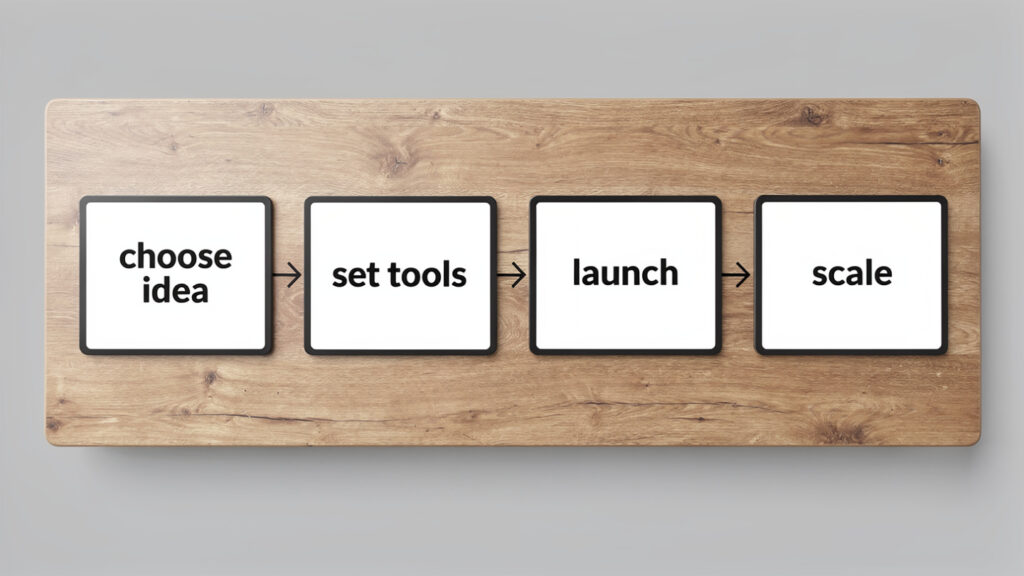
Here is the complete tool stack for a one person AI business — organized by function, with honest notes on real-world utility:
ChatGPT Plus — $20/month
The core engine of almost every AI business model in this guide. OpenAI’s GPT-4o model is meaningfully more reliable for professional-quality output than the free tier — more consistent instruction-following, better nuance, fewer errors requiring correction. Use it for content drafting, proposal writing, social media captions, client emails, and business planning.
Start with the free tier. Upgrade when your first client revenue makes the $20 feel trivial.
👉 Start with ChatGPT today — free plan, no credit card required. All seven business models in this guide can be tested before you spend a dollar.
Claude — Free / $20/month Pro
Superior for nuanced, long-form written content. If your AI business for beginners involves writing blog posts or email sequences, Claude’s ability to maintain consistent voice across 2,500+ words makes it the stronger choice for that specific use case.
Free plan is sufficient for most beginner use cases.
Canva — Free / $13/month Pro
The design tool for every visual deliverable your business produces — social media graphics, presentation decks, brand identity elements, product covers, YouTube thumbnails. AI features (Magic Design, Background Remover, Brand Kit) make professional visual output accessible without design training.
Start on free. Upgrade to Pro when client volume justifies it.
Notion — Free / $8/month Plus
The organization layer for your entire operation — client project management, prompt libraries, business planning, deliverable tracking. Notion AI (in paid plans) summarizes meeting notes and drafts client communications directly in your workspace.
Perplexity AI — Free / $20/month Pro
Real-time AI research with sourced, cited answers. Use it to research client niches before strategy calls, verify facts in content before delivery, and stay current on topics where your AI models may have outdated information. Essential for the AI online business ideas that depend on accuracy.
Pictory AI — ~$19/month
Converts scripts into fully produced YouTube videos. The core production tool for any faceless YouTube AI side hustle business.
Gumroad — Free (10% transaction fee)
Zero monthly fee. Automatic delivery. Payment processing included. The fastest path from “I have a digital product” to “I am selling a digital product.” Essential for prompt packs, digital guides, and template businesses.
Total estimated monthly cost for a complete beginner stack: $20–$60/month.
For a comprehensive review of which tools generate the highest income for each model, our guide on make money with AI covers the full toolkit by income type.
One-Person AI Business Income: What to Expect {#one-person-ai-business-income-what-to-expect}
Let’s be specific and honest. These are realistic ranges — not best-case scenarios.
| Business Model | Month 1–2 | Month 3–6 | Month 6–12+ |
|---|---|---|---|
| AI Content Writing | $200–$800 | $800–$3,000 | $2,000–$6,000 |
| Prompt Pack Selling | $50–$300 | $200–$1,000 | $500–$2,500 |
| AI Automation Services | $500–$2,000 | $1,500–$5,000 | $3,000–$10,000 |
| Faceless YouTube | $0 (building) | $0–$200 | $500–$8,000+ |
| Affiliate Blog | $0–$100 | $100–$800 | $500–$5,000+ |
| AI Graphic Design | $200–$800 | $600–$2,500 | $1,500–$5,000 |
| AI Social Media Mgmt | $300–$900 | $900–$3,000 | $2,000–$7,500 |
The honest pattern:
- Service-based models generate income fastest — often within the first two weeks
- Content and passive models take longer but have significantly higher income ceilings
- The most resilient one person AI business operations combine one service model (fast income) with one passive model (long-term compound income)
What determines where you land:
- Niche specificity — more specific = higher rates and faster client conversion
- Consistency of output and client communication
- Quality of prompting and AI tool usage
- How quickly you raise rates as your proof-of-results portfolio grows
For our comprehensive guide on AI business ideas 2026 income potential with specific launch frameworks, explore our AI tools for freelancers resource.
Common Mistakes Beginners Make
Mistake 1 — Starting with too many ideas.
Every model works. None works well when attention is split across three simultaneously. The most common reason beginners generate zero income in month one: distributing effort across five unvalidated ideas rather than executing one. Pick one. Validate it. Add a second only after the first is earning.
Mistake 2 — Over-investing in tools before validating.
You don’t need Jasper, Surfer SEO, and Pictory before your first client. Start with $0–$20/month. Add paid tools when revenue justifies each specific cost.
Mistake 3 — Publishing unedited AI output.
Every deliverable needs a human editing pass: verify facts, adjust tone, add specific examples, remove generic phrasing. The AI drafts; you finalize. Skipping this step costs client relationships and reputation. This applies to every AI business idea 2026 model that involves client-facing content.
Mistake 4 — Not niching the offer.
“I offer AI content writing” is hard to sell. “I write SEO blog posts for e-commerce pet brands” is easy to sell. Specificity generates more clients at higher rates across every service category.
Mistake 5 — Quitting at month one or two.
The pattern for almost every successful solo AI business: slow, frustrating month 1 → slightly better month 2 → genuine momentum from month 3 onward. Most people quit at month 2 — right before the compound effect begins to show. Set a minimum 90-day commitment before evaluating.
Mistake 6 — Underpricing out of insecurity.
AI-assisted results are worth the same to the client as manually produced results — if the quality is equivalent. Deliver excellent work, collect a testimonial, raise rates immediately. You charge for results, not hours.
FAQ
1. Can I start a one person AI business without coding or technical skills?
Yes — completely. Every one person AI business model in this guide runs on consumer-grade interfaces requiring zero coding. ChatGPT, Claude, Canva, Gumroad, and Zapier are all designed for non-technical users. The only skill worth developing early is effective prompting — which takes 1–2 weeks of deliberate practice.
2. How fast can I make money with a one-person AI business?
Service models (content writing, social media management, graphic design) generate first income within 7–14 days with active outreach. Digital product models see first sales in 14–30 days. Passive models (YouTube, affiliate blog) take 60–180 days before meaningful income arrives. Most committed beginners receive their first payment within 30 days.
3. What is the best AI business idea for a complete beginner?
AI content writing and AI social media management are the fastest paths to first income — immediate demand, simple tools, quick client payments. For passive income preference, AI prompt packs have the lowest barrier and can generate sales within days of listing. Choose based on income timeline: fast cash versus long-term compounding.
4. How much does it cost to start a one person AI business?
The minimum viable stack costs $0–$20/month — ChatGPT free tier ($0), Canva free tier ($0), Gumroad ($0 with 10% transaction fee), ChatGPT Plus when revenue justifies it ($20/month). Most successful AI business for beginners operations started with $20 or less and scaled tool spend as revenue grew.
5. Can a one-person AI business replace a full-time income?
Yes — but the realistic timeline is 6–18 months, not 30 days. Service-based models typically reach $3,000–$6,000/month within 6 months for focused operators. Passive models take longer but have higher ceilings. The key variable is consistency through the early quiet period — not talent or prior experience.
Conclusion: Your One Person AI Business Starts When You Decide It Does
The information in this guide is enough to launch a one person AI business this week.
Not in theory — literally this week. A Fiverr gig can be live tonight. A Gumroad product can be published tomorrow. Your first LinkedIn outreach can be sent in the next 20 minutes. The tools exist. The demand exists. The only variable is whether you act.
The uncomfortable truth: most people reading this will feel genuinely motivated and do nothing. Not because the information is wrong or the models don’t work. Because starting feels uncertain — and the familiar routine is right there.
The people who actually build an AI business from scratch aren’t more talented or more prepared. They started before they felt ready.
Your starting steps:
- Choose one model from this guide that fits your situation best
- Set up your minimum viable tool stack — ChatGPT free or Plus is enough
- Define your niche — the specific type of client or buyer you’ll serve
- Create your first offer or product within the next 72 hours
- Share it, post it, or send it to 10 potential clients
A one person AI business built today will look very different in 6 months. Not because of luck — because of the compound effect of consistent action on a model that works.
👉 Pick one model and begin now. The AI tools are ready. The market is ready. The only question is whether you decide this week is the week.
Explore more on AI Arena:
- AI side hustles — fastest-earning AI models ranked by time and effort
- Make money with AI — comprehensive guide to every AI income model in 2026
- AI tools for freelancers — the tools that make each business model work
- AI prompts guide — prompting skills that multiply the output of every AI tool you use
- Best AI tools to make money — affiliate programs, income potential, and tool comparisons
Published by AI Arena | Updated: March 2026