

Thirty days from now, you could have your first paid client, your first digital product sale, or your first affiliate commission from AI-powered content.
Or you could still be in the same place you are right now — watching other people turn AI skills to income while you bookmark another article to read later.
The difference is not skill level, technical background, or luck. The difference is whether you follow a real plan versus endlessly researching what plan to follow. This is the real plan. It is built week by week, with specific daily actions, honest income expectations, and a clear first milestone: your first $100 from AI tools.
Three thousand words of practical execution guide start now.
Who This Plan Is NOT For
This section exists because honest guides tell you who they are not for.
This plan will not work for you if:
- You want income in the next 48 hours with zero effort
- You are not willing to spend 1–2 focused hours per day for 30 days
- You plan to paste raw AI output to clients and call it a service
- You are not open to learning at least one new tool from scratch
- You expect month-one results to match month-six potential
If any of those describe you, this plan will disappoint you. Every income model here requires real effort in the building phase. What AI changes is the output-to-effort ratio — dramatically — not the need for effort itself.
If you are willing to show up consistently and follow the steps in sequence, the 30-day timeline is achievable. That is who this guide is for.
What You Need Before Starting
You do not need to wait until you have more knowledge, better tools, or more confidence. But you do need to make three decisions before you invest a single hour executing the plan.
The Tools — Minimum Stack ($0–$20/Month)
- ChatGPT (free or $20/month Plus) — the core engine for content, proposals, research, and output generation
- Claude (free plan) — strong alternative for long-form writing with consistent voice
- Canva (free) — visual deliverables, digital product covers, templates, thumbnails
- Grammarly (free) — quality control on all client-facing written output
- Notion or Google Docs (free) — workflow organization, prompt libraries, client project management
Total cost: $0 on free plans. Upgrade ChatGPT to Plus only when the first client payment makes the $20 feel trivial.
The Method — One, Not Five
The fastest path to first income is the one method you execute fully — not the five methods you split your attention across. Before reading further, choose one income method from the four covered in this guide:
- AI freelancing (service-based, fastest first income)
- AI content creation (passive model, longer timeline)
- AI automation services (highest ceiling, steepest learning curve)
- AI digital products (fastest passive model, immediate listing possible)
Write your choice down. Do not change it for 30 days.
The Mindset — Realistic Expectations Required
According to McKinsey’s research on AI productivity, AI-augmented workers demonstrate 25–40% productivity gains over non-AI counterparts in content, communications, and analysis work. That productivity advantage is the economic engine behind every AI income method here. It means you produce more, faster — which means you can serve more clients or create more products per unit of time.
What it does not mean: the AI does the work and you collect payments. The AI drafts. You direct, edit, and deliver. That distinction determines whether your clients return or leave after the first project.
AI Skills to Income in 30 Days — Complete Breakdown
This is the core of the guide. Each week has a primary objective, specific tasks, and a measurable outcome. The weeks build on each other — do not skip ahead.
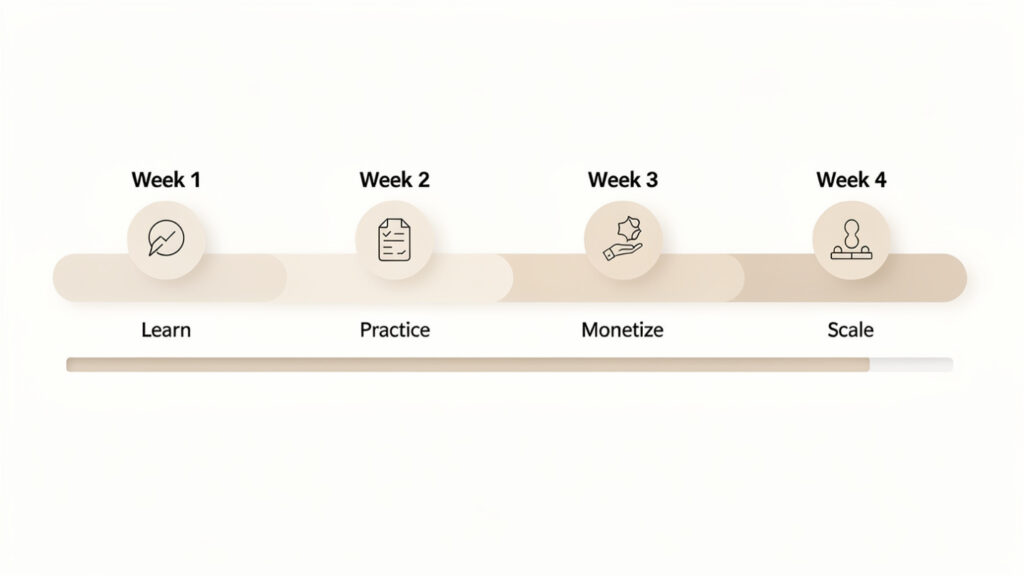
Week 1 — Learn (Days 1–7)
Primary Objective: Understand your tools at a working level, not a theoretical level.
Most people spend months in this phase because they treat learning as an infinite prerequisite. Week 1 learning is time-boxed: seven days, specific tasks, done.
Day 1–2: Choose your income method and write your offer statement. In one to two sentences: who you help, what you help them do, and what result they get. Example: “I help e-commerce brands produce SEO blog posts at twice the speed of traditional agencies, using AI-assisted writing with full editorial review.”
Day 3–4: Spend two focused hours learning the specific prompting approach your method requires. Content writers learn content prompting. Prompt pack sellers learn prompt engineering. Automation builders learn Zapier’s interface. One tool, two hours, applied specifically to your method.
Day 5–6: Study three working examples of people doing exactly what you plan to do. Fiverr gigs. Gumroad product listings. Personal websites with service offers. Note their positioning, pricing, and deliverable descriptions. Take structured notes. Do not copy — learn from the structure.
Day 7: Revise your offer statement based on what you observed in existing examples. Write it again, sharper and more specific.
Week 1 Outcome: A defined method, a working knowledge of your primary tool, and a specific offer statement that describes your service for a defined type of buyer.
Week 2 — Practice (Days 8–14)
Primary Objective: Build three portfolio pieces that demonstrate your deliverable quality to real buyers.
This is the week most beginners skip — going directly from learning to selling with nothing to show. Skipping it is why most people fail to close their first client in week 3.
Day 8–10: Build your first sample using a fictional client brief. A complete 1,500-word SEO article for a hypothetical SaaS company. A Canva template pack for a fictional real estate agency. A set of 20 engineered ChatGPT prompts for a hypothetical HR team. Make it real — not a demo, a finished deliverable.
Day 11–12: Build your second sample in a different niche. By now your prompting is faster and your editing eye is sharper than day 8.
Day 13–14: Build your third sample and organize all three in a simple Google Drive folder or Notion page. Label each with the hypothetical client type, the deliverable format, and the approximate delivery time. This is your portfolio.
Offer your real first project — to a friend, a local business, anyone — for free or significantly discounted in exchange for a written testimonial. One real testimonial from a real person converts the next client better than ten polished portfolio samples.
Week 2 Outcome: Three portfolio pieces, a portfolio page, and ideally one real testimonial from your first real project.
Week 3 — Monetize (Days 15–21)
Primary Objective: Get your first paying client or first product sale.
This is the week that separates people who build an AI income stream from people who practice building one indefinitely.
Day 15–16: Create your Fiverr gig, Gumroad product listing, or service offer page. Use ChatGPT to draft the copy — the description of your offer, what’s included, what the buyer receives, and what makes your version different from generic AI output. Price at 20–30% below established sellers. You are buying your first reviews.
Day 17–18: Post your offer once in 2–3 relevant Facebook groups for your target buyer type. Send 10 personalized outreach messages per day to LinkedIn connections who match your ideal client profile. The message structure: acknowledge a specific problem they face, describe your specific solution, invite a brief conversation. Three sentences. No long pitches.
Day 19–20: Respond to every inquiry within two hours. Show a relevant portfolio sample. Close with a clear next step — a deliverable timeline, a price, a first project scope. Not “let me know if you’re interested” — a specific invitation to begin.
Day 21: By end of week 3, something you created is either sold, actively available for purchase, or has a committed client. If neither has happened, identify the single variable causing the block: wrong positioning, wrong channel, wrong pricing, or insufficient outreach volume. Fix one variable.
how to start an AI marketing agency

Week 3 Outcome: First paying client or first product sale.
Week 4 — Scale (Days 22–30)
Primary Objective: Turn first income into a repeatable system.
Day 22–24: Document your delivery workflow in writing — every step from receiving a client brief to delivering a completed project. This becomes your delivery template for every future client. Consistency and speed compound together as your template improves.
Day 25–27: Request a testimonial from every satisfied client or buyer. A direct, simple request: “I’m glad the project worked well for you. Would you be willing to leave a brief review on [platform]? And if you know anyone who needs [specific service], I’d appreciate the introduction.”
Day 28–29: Add a second income stream that uses the same tools and skills as your primary method. If you have been doing freelance content writing, build a prompt pack and list it on Gumroad. If you have been selling templates, write one affiliate article targeting a relevant keyword. The second stream is passive alongside your active service work.
Day 30: Set specific targets for month two: number of clients, number of products, income target. Most people who reach consistent AI income do so in months 3–4 — month one is about proving the model works for you personally.
Week 4 Outcome: A documented workflow, at least one testimonial, a second income stream in early stages, and a concrete month-two plan.
Your First $100 Plan
Before the 30-day plan even begins, here is the fastest path to your first $100 from AI tools — specifically designed for people who want proof of concept before committing to a full 30-day execution.
The fastest path: One Fiverr gig, one client, one article.
- Create a Fiverr account in the next 24 hours
- Use ChatGPT to write a Fiverr gig listing for “SEO blog post writing for small businesses” — 1,500 words for $85
- Set up your gig with two portfolio samples you create in the next 48 hours
- Post your Fiverr URL once in a relevant Facebook group for small business owners or startup founders
- Respond to your first inquiry within 30 minutes of receiving it
- Deliver a polished, edited, fact-verified article within the agreed timeline
- Request a review as soon as the client confirms satisfaction
Total time to first $100: 5–10 days from gig creation if you follow these steps exactly. This is not guaranteed — but it is the approach most consistently cited by beginners who generated their first AI income quickly. The article at this price point takes 60–90 minutes with ChatGPT — leaving a genuine profit margin on your time investment.
If you are willing to do this one thing before starting the full 30-day plan, do it. The psychological impact of your first paid AI project changes how you execute everything that follows.
Best AI Skills That Make Money in 2026
Not all AI skills are equally valuable in the current market. These are the ones with documented demand and measurable income potential:
AI Prompt Engineering
The foundational skill for every income method here. Learning to write structured prompts that produce professional-quality outputs consistently — rather than generic outputs that require heavy rewriting — is the single most impactful skill improvement you can make in your first 30 days. It is also directly monetizable as prompt packs sold on Gumroad or PromptBase.
AI-Assisted Content Writing
Using AI tools to produce SEO blog posts, email sequences, website copy, and social media content at 3–5x the speed of manual writing. The skill is not typing speed — it’s briefing the AI accurately for specific client needs and editing outputs for voice, accuracy, and genuine usefulness.
AI Visual Content Creation
Using Midjourney, Canva AI, or Adobe Firefly to produce professional brand graphics, templates, social media content, and digital art. Increasingly in demand from small businesses who need consistent visual content without agency pricing.
AI Workflow Automation
Using no-code platforms (Zapier, Make) to build automated business processes for small businesses. The highest-income skill in this list for people willing to invest in learning the platforms — businesses pay $500–$3,000 per automation build.
AI Video Production
Using Pictory, ElevenLabs, and CapCut to produce faceless YouTube channels, video marketing content, and audiobooks. The strongest passive income with AI model because content continues generating revenue indefinitely after production.
According to Forbes on AI entrepreneurship trends, demand for AI-augmented professional services is projected to grow significantly through 2026 — with content writing, automation consulting, and visual content production showing the strongest individual creator income potential.
Best AI Tools for Making Money — Real Use Cases
ChatGPT Plus ($20/month)
The most versatile AI tool for making money across every income method here. Client article drafts, prompt pack engineering, affiliate article outlines, proposal templates, email sequences, social media content. Use the Custom GPT feature to create a business assistant trained on your services, pricing, and communication style.
Claude (Free — Anthropic)
Superior to ChatGPT for nuanced, long-form content where voice consistency matters across 2,000+ words. For content writing clients who care about human-sounding prose rather than recognizable AI output, Claude is the stronger first-draft tool.
Canva AI (Free / $13/month)
Essential for all visual deliverables — templates, social media content, digital product covers, presentation decks, YouTube thumbnails. The AI design features in Canva’s free tier are sufficient for beginner-level AI income work.
Perplexity AI (Free)
Real-time research with sourced, cited answers. Use it to verify facts in client deliverables before submission and to research client industries before strategy calls. Prevents AI confabulation errors that permanently damage client trust.
Pictory AI (~$19/month)
Converts written scripts into fully produced YouTube videos. The core production tool for faceless YouTube channels and video content services — the primary platform for AI content creation income through AdSense and affiliate links.
Gumroad (Free — 10% transaction fee)
Zero monthly fee, automatic digital delivery, built-in payment processing. The fastest path from “I have a digital product” to “I am actively selling a digital product.” Essential for prompt packs, guides, and template businesses.
Zapier (Free tier)
The entry point for AI automation services. Visual, no-code workflow builder. Build automation sequences for small business clients and charge for both the initial build and ongoing maintenance.
For a complete comparison of these tools organized by income method and skill level, see our guide to the best AI tools for freelancers.
Real Ways to Make Money With AI
AI Freelancing
The fastest path to first income. You offer AI-assisted services — content writing, social media management, graphic design, research, copywriting — through Fiverr, Upwork, or direct outreach.
How it works economically: AI compresses your production time from 3–4 hours per deliverable to 60–90 minutes without reducing the buyer’s perceived value of the output. That time efficiency is the income multiplier. A writer who produces 3x more articles per week at the same quality level earns 3x more from the same hours.
Realistic income: $500–$3,000/month by month 3 with consistent client acquisition and a specific niche.
AI Content Creation Income
Faceless YouTube channels, affiliate blogs, and newsletter businesses powered by AI production tools. You create content once — it generates income indefinitely through AdSense, affiliate commissions, and sponsorships.
Trade-off: Longer time to first meaningful income (60–180 days) versus significantly higher income ceilings and substantially less active time investment once the content library is built.
Realistic income: $200–$500/month by month 4 for YouTube with consistent publishing; $300–$2,000/month by month 6 for affiliate blogs.
AI Automation Services
You build no-code automation workflows for small businesses. No coding required. Businesses pay $500–$3,000 per automation build plus $200–$600/month for ongoing maintenance retainers.
The income model is different from other methods: you are not selling your time or your content — you are selling business outcomes. A workflow you build in 8 hours that saves a business owner 10 hours per week indefinitely is worth significantly more than an hourly rate would suggest.
Realistic income: $1,000–$6,000/month by month 3 for focused operators.
AI Digital Products
Prompt packs, digital guides, templates, audiobooks, and online courses produced with AI assistance and sold on Gumroad, Etsy, or PromptBase.
The fastest entry: A 30–50 prompt pack for a specific professional audience, listed at $15–$49. Five to seven hours of creation for a product that generates passive income with AI tools every month with zero additional fulfillment effort.
Realistic income: $100–$1,500/month from a library of 5–10 products, typically by month 2.
For more on building these streams alongside active service work, explore our AI side hustles guide.
Income Method Comparison: Which Is Right for You?
| Method | Time to First Income | Monthly Potential (Month 6) | Difficulty | Passive? |
|---|---|---|---|---|
| AI Freelancing | 7–14 days | $2,000–$6,000 | Low–Medium | No |
| AI Content Creation | 60–180 days | $500–$5,000+ | Medium | Yes |
| AI Automation Services | 14–30 days | $3,000–$8,000 | Medium–High | Partial |
| AI Digital Products | 7–21 days | $500–$2,500 | Low | Yes |
How to read this table:
- If you need income quickly and are comfortable talking to clients: AI freelancing is your method.
- If you have patience and want income that grows without your daily presence: AI content creation or digital products.
- If you are technically inclined and want the highest income ceiling: AI automation services.
- If you want fast passive income with the lowest barrier to entry: AI digital products (prompt packs specifically).
Most successful AI income builders combine one active and one passive method — one for immediate cash flow, one for compound growth.
Realistic Income Expectations

These are documented ranges — not best-case scenarios or income guarantees.
Month 1 honest benchmarks:
- AI freelancing: $200–$800 (with active daily client outreach from day 15 onward)
- AI digital products: $50–$300 (with a prompt pack or template listed and promoted)
- AI content creation: $0–$100 (building phase — no meaningful income from views or affiliate yet)
- AI automation services: $500–$2,000 (if you have one committed client before month end)
Month 3 realistic benchmarks:
- AI freelancing: $800–$3,000 (with 3–5 consistent clients and refined positioning)
- AI digital products: $200–$1,000 (with a library of 3–5 products and organic platform discovery)
- AI content creation: $100–$500 (early traction for consistently published, well-positioned content)
- AI automation services: $1,500–$5,000 (with 2–3 clients on maintenance retainers)
Month 6 realistic benchmarks:
- AI freelancing: $2,000–$6,000 (with established reputation and repeat client base)
- AI digital products: $500–$2,500 (compound passive income from growing product library)
- AI content creation: $500–$5,000+ (for channels or blogs with consistent 6-month publishing histories)
- AI automation services: $3,000–$8,000 (with documented case studies and recurring retainer clients)
According to Harvard Business Review research on digital platform freelancers, top performers in any digital service category are distinguished not by technical skill but by niche specificity and client communication quality. Both factors are within your control starting on day one — regardless of AI tool experience.
Common Mistakes to Avoid
Mistake 1 — Infinite preparation.
There is no preparation level that makes launching feel comfortable. The discomfort of launching is the signal to act — not the reason to wait. Set a hard rule: something live or sold by day 21.
Mistake 2 — Competing purely on price.
Beginners who price 70% below market rates attract the most demanding, least satisfied clients and burn out before month 2. Price 20–30% below established sellers to build reviews. Compete on niche specificity and responsiveness — not on being cheapest.
Mistake 3 — Delivering unedited AI output.
Every client deliverable needs a human editing pass: verify facts, adjust tone, add specific examples, remove generic phrasing. Clients who receive obviously AI-generated content — predictable, generic, without added judgment — do not return. The repeat business that makes month 2 easier than month 1 depends on this.
Mistake 4 — Choosing a broad offer.
“I offer AI writing services” is invisible in search and indistinguishable in a client’s mind from the next 500 results. “I write SEO blog posts for healthcare technology companies” is findable, memorable, and clearly relevant to a specific buyer. Niche specificity feels limiting. In practice, it generates faster client acquisition and higher rates.
Mistake 5 — Evaluating too early.
Month 1 results are not representative of what the model produces at month 3 or 6. The compound effect of consistent positioning, improving prompting quality, and growing client reputation does not show up in week one. Set a minimum 90-day commitment before deciding whether a method is working.
Mistake 6 — Skipping the portfolio phase.
Reaching out to clients with no examples and no prior work to show is like applying for a job with a blank resume. Two weeks of building real samples dramatically changes close rates in week 3. The portfolio phase is not optional.
Your Action Plan: 30-Day Checklist
Week 1 — Learn
- Choose one income method
- Write your offer statement (who you help + what you deliver + what result they get)
- Spend two focused hours learning your primary AI tool
- Study three working examples of your chosen income method in action
- Revise your offer statement to be more specific
Week 2 — Practice
- Build three portfolio samples using fictional client briefs
- Complete one real project (free or discounted) for a testimonial
- Create your portfolio page in Google Drive or Notion
- Refine your prompting approach until you can produce a deliverable in under 60 minutes
Week 3 — Monetize
- Create your Fiverr gig, Gumroad listing, or offer page
- Use ChatGPT to write all your offer copy
- Post in 2–3 relevant communities
- Send 10 personalized outreach messages daily
- Respond to every inquiry within two hours
- Close your first paid project or sale by day 21
Week 4 — Scale
- Document your full delivery workflow as a reusable template
- Request a testimonial from every satisfied client
- Add one complementary income stream using the same tools
- Set specific month-two targets: clients, products, income
For the prompt engineering frameworks that make every deliverable above reliably professional, see our AI prompts guide.
FAQ
1. Can beginners make money with AI without prior experience?
Yes. The most accessible AI jobs for beginners — content writing, social media management, and prompt pack selling — require no prior professional experience. You need to learn to use the tools (1–2 weeks) and position a specific offer for a specific buyer. Prior experience in any field accelerates income but is not required to start.
2. How long does it realistically take to earn money with AI?
Service-based methods generate first income within 7–21 days with active outreach. Digital product methods see first sales within 7–30 days. Passive content models (YouTube, affiliate blogs) take 60–180 days before meaningful income arrives. Consistent monthly income that feels significant typically develops over 3–6 months for any method.
3. What AI skills are most profitable in 2026?
In order of documented income potential: AI automation services ($1,000–$8,000/month), AI content writing at scale ($2,000–$6,000/month with consistent clients), AI visual content ($500–$5,000/month), and AI digital products ($200–$2,500/month passive). The most profitable skill is always the one you can deliver at a quality level that generates repeat business — not the one with the highest theoretical ceiling.
4. Is AI freelancing worth it in 2026?
Yes — with a clear condition. AI freelancing is worth pursuing if you position specifically for a defined niche and invest in quality editing of your AI-assisted output. It is not worth pursuing if you treat it as a commodity service competing purely on price. The market for AI-augmented professional services is expanding, but supply is growing alongside it. Niche specificity and output quality are the differentiators that make the difference.
5. How much can you realistically earn with AI tools in your first month?
A realistic first-month range with focused effort: $200–$800 from service work, $50–$300 from digital products, and $0–$100 from content-based passive methods. These are starting numbers — not ceiling numbers. By month 6, focused operators typically earn $2,000–$5,000/month. These results require active client acquisition, specific niche positioning, and consistent quality — not passive effort or random outreach.
Conclusion: 30 Days Is Enough — If You Start Today

The information in this guide is enough to begin this week. Not next month when you feel more prepared. Not after you finish one more course. This week.
The gap between people actively earning money using AI tools and people researching how to do it is not skill level, technical expertise, or access to special information. It is the decision to start — and the commitment to execute consistently past the point where the effort feels unrewarded.
The 30-day plan works because it is built around one principle: do the minimum viable thing required to reach the next milestone, then do it again. Learn enough to practice. Practice enough to sell. Sell enough to scale. The simplicity is not a limitation — it is the mechanism.
You have the tools. You have the plan. The 30-day clock starts tonight.
Explore more on AI Arena:
- Best AI tools for freelancers — every tool reviewed by income method and skill level
- Make money with AI — comprehensive guide to every AI income model in 2026
- AI side hustles — fastest-earning AI models ranked by timeline and effort
- AI tools for productivity — the tools that maximize output per hour across every business model
- AI prompts guide — the prompting frameworks that make every deliverable professional
Published by AI Arena | Updated: March 2026