
The Problem Every Small Business Owner Recognises
How small businesses can use AI in 2026 is no longer a question — it’s a necessity. Small businesses can use AI in 2026 to automate tasks, improve marketing, and grow faster without hiring large teams.

That gap used to come down to budget. It no longer does.
The AI tools that large enterprises spent millions building internally are now accessible to any business owner with a laptop and a monthly subscription costing less than a restaurant meal. Knowing how small businesses can use AI to close that gap is now one of the most valuable skills an entrepreneur can develop.
This guide covers nine practical use cases — with specific tools, real business examples, and one actionable tip for each. No theory. Just what works.
[INSERT IMAGE 1]
Placement: After the introduction
ALT text: “how small businesses can use AI to compete with larger companies in 2026”
Caption: “AI tools give small businesses the capabilities that once required an entire team.”
9 Practical Ways How Small Businesses Can Use AI to Grow
According to McKinsey Global Institute, generative AI could automate tasks accounting for up to 70 percent of employees’ time across industries. For small businesses, that is not a threat — it is an invitation.
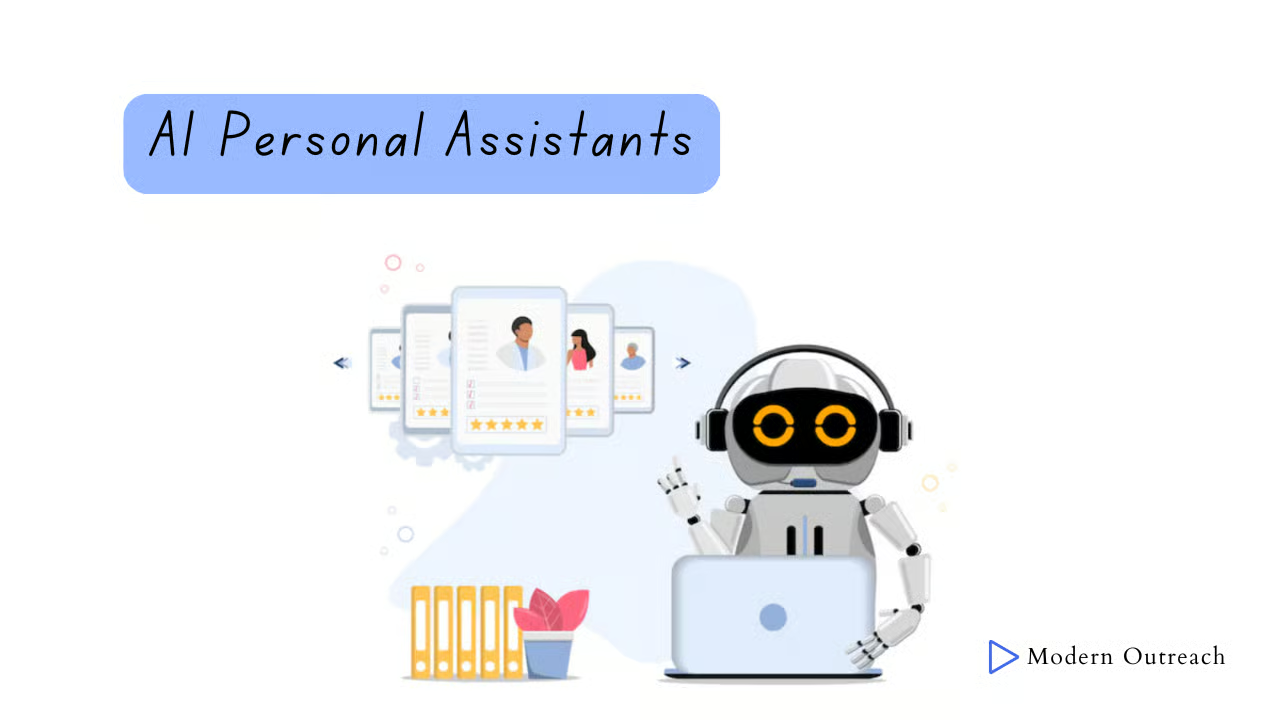
1. Automate Customer Service Without Losing the Human Touch
The use case: Every unanswered customer message is a potential lost sale. AI chatbots now handle the majority of common enquiries — order status, business hours, product questions, refund policies — instantly, around the clock, without staff involvement.
How it works: Install an AI chatbot on your website or social media. It resolves tier-one questions automatically and escalates anything complex to a human. Response times drop from hours to seconds. Nothing falls through the cracks at 2am.
Real example: A small e-commerce clothing brand in Manchester installed Tidio in early 2025. Average response time dropped from four hours to under two minutes. Customer satisfaction scores improved by 34 percent within three months. The founder reclaimed approximately 12 hours per week.
Tools to use: Tidio, Intercom, Freshdesk
Actionable tip: Start by listing your ten most frequently asked customer questions. Build your chatbot’s initial responses around those. Review real conversation logs monthly and refine.
2. Create Marketing Content in a Fraction of the Time
The use case: Blog posts, social media captions, email newsletters, product descriptions — the content machine never stops. AI writing tools make it manageable for a team of one.

How it works: Use an AI writing assistant to generate first drafts and outlines. A business owner who previously spent three hours on a weekly newsletter now finishes it in thirty minutes — spending the saved time on editing, strategy, or customers.
Real example: A one-person interior design consultancy in Dublin uses ChatGPT to draft Instagram captions, blog posts, and email campaigns each week. Content output tripled while time investment halved. Website traffic grew 60 percent over six months through consistent publishing.
Tools to use: ChatGPT, Jasper, Copy.ai
Actionable tip: Create a reusable prompt template specific to your business — brand tone, target audience, key messages. Consistent prompting produces consistent, on-brand output.
For a full breakdown of the best content tools for business owners, see our guide to AI tools for blogging and content creation.
[INSERT IMAGE 2]
Placement: After the content creation section
ALT text: “small business owner using AI tools for content creation and marketing in 2026”
Caption: “AI writing tools let solo business owners produce the content volume of an entire marketing team.”
3. Rank on Google Without Hiring an SEO Agency
The use case: Ranking on Google drives organic traffic that costs nothing to maintain. Small businesses typically cannot afford agencies charging $1,500–$5,000 a month. AI-powered SEO tools make professional-level optimisation accessible to anyone.
How it works: Tools like Surfer SEO analyse top-ranking pages for your target keywords and tell you exactly how to structure your content — word count, headings, semantic keywords — to compete with them. Data-driven guidance, no expert required.
Real example: A family-run accountancy firm in Birmingham used Surfer SEO to optimise five service pages. Within four months, two pages reached the first page of Google for competitive local keywords — generating consistent inbound enquiries for the first time without paid advertising.
Tools to use: Surfer SEO, Semrush, Ubersuggest
Actionable tip: Start with your highest-value service page. Run it through Surfer SEO, implement the recommendations, and monitor ranking movement over 60–90 days before moving to the next page.
4. Generate and Qualify Leads Automatically
The use case: Finding and qualifying potential customers is one of the most resource-intensive parts of running a small business. AI tools handle initial outreach, lead scoring, and follow-up sequences — reducing manual workload significantly.
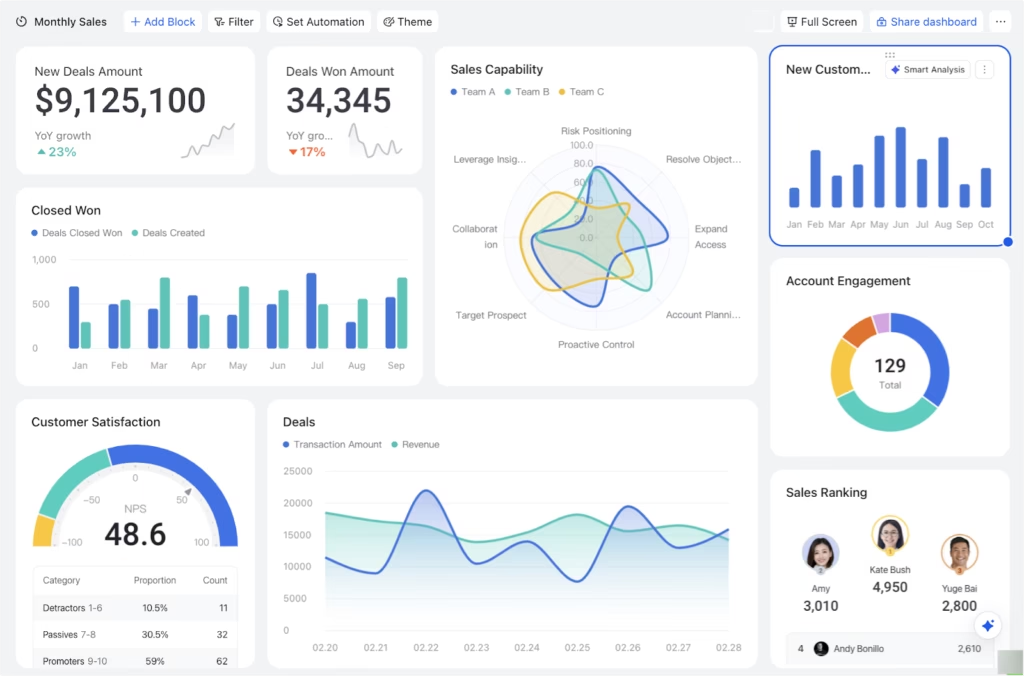
How it works: AI-powered CRM tools analyse prospect behaviour, assign lead scores based on engagement signals, and trigger follow-up messages at the right moment. Your sales effort concentrates on the leads most likely to convert.
Real example: A small B2B software company in Amsterdam implemented HubSpot with AI-assisted lead scoring in Q3 2024. Their sales team shifted from 200 weekly follow-ups to 40 high-priority leads. Conversion rate increased from 8 percent to 19 percent within two quarters.
Tools to use: HubSpot, Pipedrive, Apollo.io
Actionable tip: Define exactly what a qualified lead looks like for your business — industry, company size, engagement signals — before configuring any lead scoring tool. Precise input criteria produce precise output.
5. Automate Repetitive Business Workflows
The use case: Invoice sending, appointment confirmations, data entry, client onboarding, social media scheduling — AI automation tools handle these invisibly while your attention goes elsewhere.
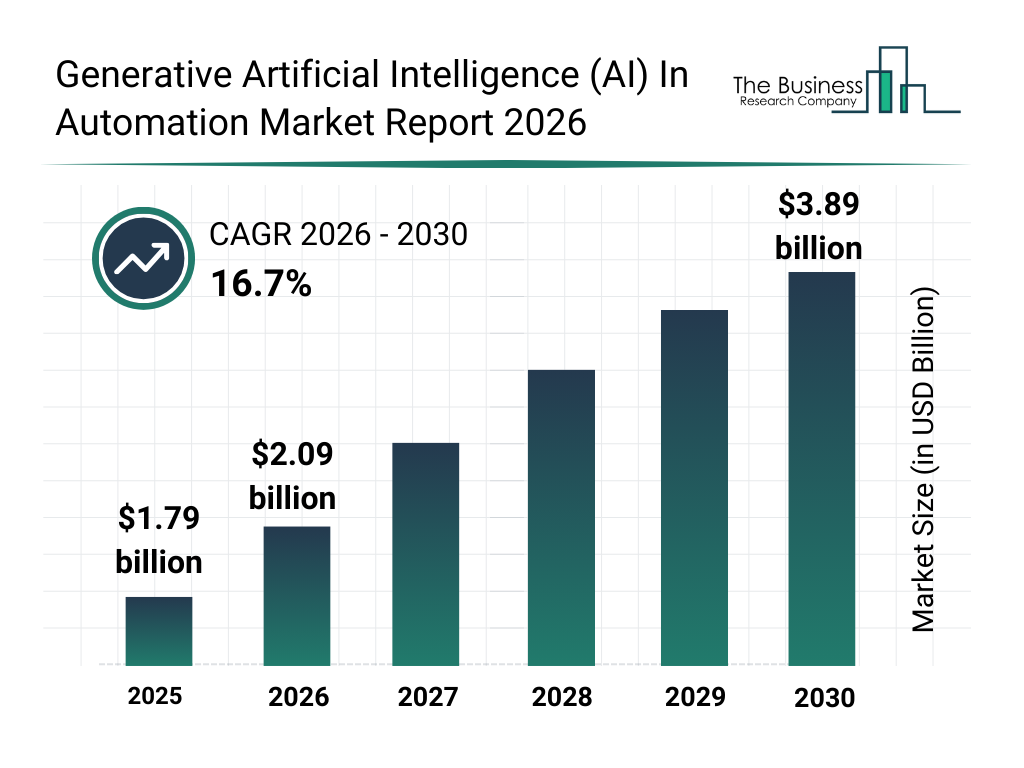
How it works: No-code automation platforms connect your existing apps and trigger actions automatically. A new contact form submission can trigger a confirmation email, CRM record creation, calendar task, and Slack notification — without human involvement at any step.
Real example: A freelance photographer in Toronto built a client onboarding automation using Make. A welcome email, contract request, and invoice now send within minutes of a booking confirmation. What previously took 45 minutes of admin per client now takes zero.
Tools to use: Make, Zapier, n8n
Actionable tip: Map out every repeatable task you do more than three times per week. Any task that moves information from one place to another — form to spreadsheet, enquiry to invoice — is a strong automation candidate.
[INSERT IMAGE 3]
Placement: After the workflow automation section
ALT text: “how small businesses can use AI automation to eliminate repetitive tasks and save hours each week”
Caption: “Workflow automation tools handle the operational tasks that drain small business owners most.”
6. Personalise Email Marketing at Scale
The use case: Generic email blasts produce generic results. AI-powered email tools personalise messaging based on subscriber behaviour, purchase history, and engagement — making every email feel individually written even when sent to thousands.
How it works: AI segments subscribers by behaviour automatically and sends different content to different groups. A customer who browsed your pricing page receives different messaging than one who last purchased eighteen months ago.
Real example: A small skincare brand in Sydney implemented AI-driven segmentation through Klaviyo in 2025. Email open rates rose from 22 percent to 41 percent. Revenue from email campaigns grew 67 percent in the following quarter — with no change to subscriber list size.
Tools to use: Klaviyo, Mailchimp, ActiveCampaign
Actionable tip: Begin with a simple two-segment approach — new subscribers versus returning customers. Different welcome sequences for each group produce significant improvement in engagement with minimal setup.
7. Make Smarter Decisions with AI Analytics
The use case: AI analytics tools help small business owners identify trends, spot problems early, and make confident decisions — without a data analyst on staff.
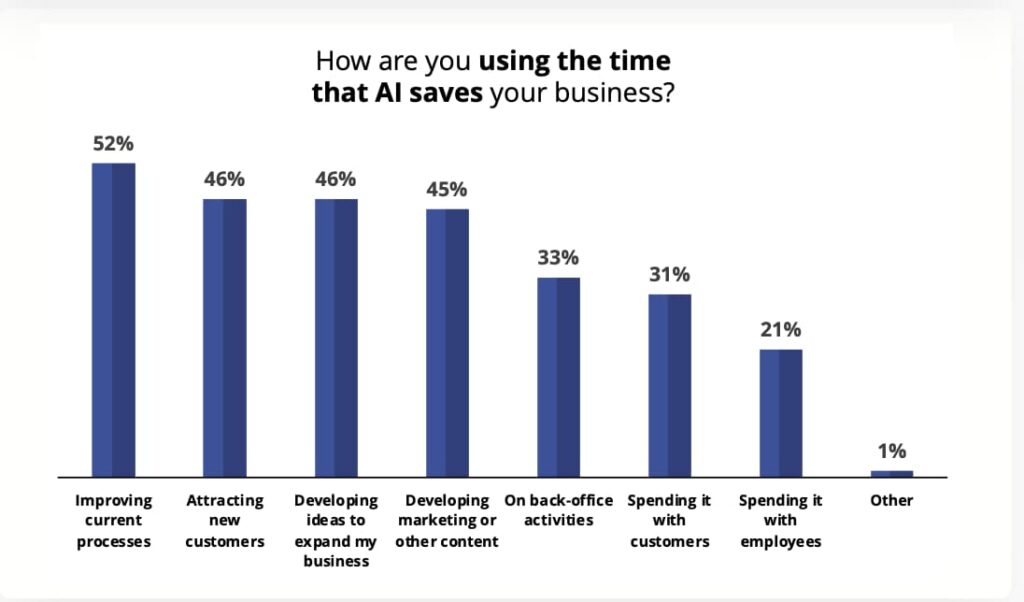
How it works: Connect your sales, website, and customer data to an analytics platform. AI surfaces what is working and what is not — which products are trending, which traffic sources convert best, which customers are at risk of churning — in plain language rather than impenetrable dashboards.
Real example: A small restaurant group in Melbourne used Tableau with AI-assisted insights to identify that 68 percent of bookings came from a single postcode radius, and that Tuesday reservations significantly underperformed. A targeted local promotion and Tuesday discount increased weekly covers by 23 percent within eight weeks.
Tools to use: Tableau, Google Looker Studio, Zoho Analytics
Actionable tip: Start with one question you genuinely cannot answer right now — “Which product has the highest margin?” or “When do most customers stop buying?” Build your analytics setup to answer that question first.
8. Manage Online Reviews Intelligently
The use case: Online reviews directly influence purchasing decisions. Managing review volume, responding promptly, and extracting recurring themes from customer feedback is time-consuming — and AI tools streamline all three.
How it works: AI tools monitor review platforms across Google, Trustpilot, Yelp, and social media, flag new reviews immediately, suggest personalised responses, and identify sentiment patterns across large volumes of feedback.
Real example: A dental practice in Edinburgh used Birdeye to manage reviews across four platforms. Within six months, their Google rating increased from 3.9 to 4.6 stars. New patient enquiry volume visibly increased as a direct result.
Tools to use: Birdeye, Podium, Yext
Actionable tip: Respond to every review — positive and negative. A professional, prompt response to a negative review often impresses prospective customers more than the original complaint damages you.
9. Streamline Hiring and HR Administration
The use case: For growing small businesses, recruitment admin becomes an unexpected drain. AI tools automate job description writing, CV screening, interview scheduling, and onboarding workflows.
How it works: AI recruitment tools rank incoming applications against defined criteria automatically, flag top candidates, and send interview scheduling links without manual coordination. AI-generated job descriptions attract higher-quality applicants through clearer, more inclusive language.
Real example: A digital marketing agency in London used Workable to hire a senior content manager. The AI screened 180 applications and surfaced the top 12 candidates in under 24 hours. The founder estimated 15 hours saved compared to manual CV review.
Tools to use: Workable, Greenhouse, Manatal
Actionable tip: Define three or four non-negotiable criteria for any role before configuring AI screening. Specific criteria produce specific — and useful — shortlists.
[INSERT IMAGE 4]
Placement: After the hiring section
ALT text: “small business owner reviewing AI-screened candidates — how small businesses can use AI for smarter hiring”
Caption: “AI hiring tools cut CV review time from days to hours, so founders can focus on the interviews that matter.”
AI Tools for Small Business — Quick Comparison
| Use Case | Recommended Tool | Free Plan | Best For |
|---|---|---|---|
| Customer service automation | Tidio | Yes | E-commerce, service businesses |
| Content creation | ChatGPT | Yes | Any business type |
| SEO optimisation | Surfer SEO | Trial | Businesses targeting Google traffic |
| Lead generation and CRM | HubSpot | Yes | B2B, professional services |
| Workflow automation | Make | Yes | Any business with repetitive tasks |
| Email marketing | Klaviyo | Yes (up to 250 contacts) | E-commerce, product businesses |
| Business analytics | Looker Studio | Yes | Any business with data to analyse |
| Review management | Birdeye | Trial | Hospitality, healthcare, retail |
| Recruitment | Workable | Trial | Businesses beginning to hire |
How to Get Started: A Practical Entry Point
Nine use cases is a lot to process. Here is a simpler approach.
Step 1 — Choose one. Pick the use case where you lose the most time or leave the most opportunity unrealised. For most small businesses, that is customer communications, content creation, or workflow automation.
Step 2 — Use free tiers first. Almost every tool mentioned here has a free plan or trial. Test before investing. A tool used consistently on a free plan creates more value than a premium subscription that sits unused.
Step 3 — Measure the impact. Define success before you start — time saved, response rate improved, content published per month. Review after 60 days. Results tell you whether to invest further or try a different approach.
For a broader overview of AI tools that drive business efficiency, see our guide to the best AI tools for productivity in 2026. And if you’re thinking about how AI can create revenue alongside your business, our guide on how to make money with AI in 2026 covers exactly that.
Conclusion: The Competitive Advantage Is Available Right Now
The businesses growing fastest in 2026 are not necessarily the ones with the biggest budgets or the largest teams.
They are the ones that identified where AI gives them leverage — and acted on it.
Every tool in this guide is accessible to a business owner with no technical background. Most have free starting points. The learning curve for each is measured in hours, not months.
Start with one use case this week. Sign up for the free trial. Apply it to a real problem your business faces today. Measure what changes. Then build from there.
The window for early-mover advantage in small business AI adoption is still open — but competitive advantage always has a shelf life.
Frequently Asked Questions
How can small businesses use AI effectively without a technical team?
Small businesses can use AI effectively by starting with no-code tools that require no programming knowledge — platforms like Make, Tidio, and ChatGPT are designed for non-technical users. The most effective approach is identifying one specific, recurring business problem and testing a single tool against it. Clear use cases produce clear results, even without technical expertise.
Is AI worth it for small businesses, or is it just hype?
AI is worth it for small businesses when applied to real operational problems — slow customer response times, inconsistent content production, missed follow-ups, and time-consuming admin. The businesses dismissing it as hype are often those still doing manually what could be automated in an afternoon. The right question is not whether AI works in general, but whether there is a specific problem in your business that a free or low-cost AI tool could solve faster and cheaper than the current approach.
What are the best AI tools for small business in 2026?
The best AI tools for small business depend on the use case. For customer service, Tidio and Intercom. For content creation, ChatGPT and Jasper. For workflow automation, Make and Zapier. For email marketing, Klaviyo. For SEO, Surfer SEO. Start with the category that matches your most pressing operational challenge.
How much does implementing AI cost for a small business?
Less than most business owners expect. Many of the most useful AI tools have plans starting at zero. Paid plans for the tools in this guide typically range from $9 to $100 per month. The ROI calculation is usually straightforward: if a $20/month tool saves three hours of your time weekly, and your time is valued at $50/hour, it returns $580 in saved time per month. Start with free tiers, validate the value, and upgrade when the return is clear and consistent.
Will AI replace employees in a small business?
For most small businesses, AI replaces tasks, not people. It handles the repetitive, volume-based components of roles — answering common customer questions, scheduling posts, formatting data — freeing existing staff to focus on higher-value work requiring judgment, relationships, and creativity. The businesses using AI most effectively tend to grow their teams over time, because AI-driven efficiency generates the capacity and revenue that makes hiring possible.
Published on AI Arena — reviewing and comparing AI tools for productivity, business growth, and content creation. Updated March 2026.