
The best AI tools for research in 2026 are transforming how students and professionals find, analyze, and organize information
Research has never been straightforward. Finding the right sources, reading through lengthy papers, extracting what matters, keeping track of citations, and turning everything into coherent written work — even experienced researchers find the process exhausting and slow.
In 2026, AI research tools are making a measurable difference at every stage of that process. They help researchers find relevant academic sources faster than keyword searches alone, summarise papers automatically so you can evaluate relevance before committing to a full read, analyse findings across multiple studies at once, and organise collected knowledge into structured, searchable workspaces that actually hold up as projects grow.
This guide covers the eight best AI tools for research currently available — evaluated honestly for what they do well, where they fall short, and who they suit best.
If you also need help writing essays or research reports, see our guide to the best AI writing tools in 2026. Students looking for study assistants should also explore our list of the best AI tools for students in 2026.
Why AI Research Tools Are Useful in 2026
The volume of published academic work has become almost impossible to navigate manually. Millions of papers are added to research databases every year. No individual researcher — and no research team — can read everything relevant to even a narrow topic.
AI research assistants address this by doing the reading, sorting, and surface-level analysis that has traditionally consumed the most time. They do not replace critical thinking or domain expertise, but they free up considerably more time for both.
The researchers, students, and academics seeing the most benefit in 2026 are those using AI tools for specific, well-defined tasks: literature discovery, paper summarisation, citation analysis, evidence synthesis, and research organisation. The tools that do those things well are reviewed below.
The 8 Best AI Tools for Research in 2026
1. ChatGPT – Best AI Research Assistant
What the tool does
ChatGPT is a conversational AI assistant that functions as a capable general-purpose research companion. It explains complex concepts, helps users develop and refine research questions, summarises materials provided to it, and assists with research design and methodology planning. While it is not a dedicated academic database, it is often the most useful starting point when approaching an unfamiliar topic.
Key features
- Detailed, plain-language explanations of complex academic and scientific concepts
- Research question generation and scope refinement
- Summarisation of texts, papers, and documents you upload or paste in
- Methodology and research design guidance across disciplines
- Document and PDF analysis on the paid plan
- Broad coverage of sciences, humanities, social sciences, and professional fields
Best use cases
- Building an initial understanding of an unfamiliar research area before searching databases
- Generating a focused list of research questions before starting a literature review
- Understanding the methodology or statistical approach in a paper you find difficult to interpret
- Producing structured summaries of long documents for quicker evaluation
Pros
- Handles an unusually wide range of research tasks and subject areas
- Free tier (GPT-4o) is capable enough for most daily research support needs
- Conversational format allows natural follow-up and progressive refinement of responses
Cons
- Does not search live academic databases — draws on training data, not real-time literature
- Does not cite sources automatically; claims require independent verification
- Training cutoff means the most recent publications may not be reflected in responses
Pricing: Free. ChatGPT Plus costs $20/month and adds document uploads, file analysis, and priority access.
2. Perplexity AI – Best AI Search Engine for Research
What the tool does
Perplexity AI is an AI-powered search engine that answers research questions using live web data and includes a clickable source citation with every claim it makes. Unlike standard search engines, it synthesises information from multiple sources into a single coherent answer — removing the need to open, skim, and close dozens of individual pages.
Key features
- Live web search built into every answer, drawing on current information
- Source citations with direct links provided for every response
- Academic Focus mode for searching peer-reviewed papers and scholarly sources specifically
- Follow-up question threading for progressively deeper topic exploration
- Clean, distraction-free interface on both web and mobile
- No account required for basic use
Best use cases
- Getting a sourced overview of a topic before going deeper into primary literature
- Checking whether a specific claim has credible published sources behind it
- Using Academic Focus mode to surface peer-reviewed papers on a defined research question
- Rapid fact-checking during the writing phase of a research project
Pros
- Every answer includes visible, clickable citations — critical for academic credibility
- Draws on current, live web data rather than a fixed training dataset
- Academic mode makes it immediately more appropriate for formal research tasks
Cons
- Source quality still varies and requires manual verification before formal citation
- Pro search queries are limited on the free tier
- Less useful for document analysis, writing support, or organisational tasks
Pricing: Free. Perplexity Pro costs $20/month for unlimited AI-powered searches.
3. Elicit – Best AI Tool for Academic Papers
What the tool does
Elicit is an AI research assistant built specifically for working with academic literature. It searches a database of over 200 million papers based on the semantic meaning of your research question — not just keyword matching — and automatically extracts key findings, methodology, sample sizes, and limitations from each result.
Key features
- Semantic search across 200 million-plus academic papers
- Automatic extraction of key claims, methods, and conclusions per paper
- Side-by-side comparison table of findings across multiple studies
- Literature review table generation with structured extracted data
- Individual paper summarisation into concise key points
- Export options for structured research notes and tables
Best use cases
- Conducting systematic or rapid literature reviews on a focused research question
- Comparing how multiple studies approach the same problem or question
- Extracting structured data from large numbers of papers without reading each one in full
- Identifying the strongest and most consistent evidence on a specific claim
Pros
- Purpose-built for academic research — considerably more focused than general AI assistants
- Structured extraction tables save hours of manual note-taking during literature review
- Side-by-side comparison is particularly valuable when evidence across studies varies
Cons
- Coverage is strongest in biomedical and social science fields; some disciplines are less well represented
- AI-generated summaries require verification against the original source
- Interface requires some familiarisation before the workflow becomes efficient
Pricing: Free tier available with limited monthly searches. Elicit Plus costs $12/month for expanded access.
4. Consensus – Best AI Tool for Scientific Research
What the tool does
Consensus is an AI-powered academic search engine that synthesises findings from peer-reviewed studies and provides a direct, evidence-based answer to your research question. It focuses specifically on what the research actually says — not just which papers exist — and shows the degree of agreement or disagreement across the literature.
Key features
- Evidence-based answers drawn directly from peer-reviewed scientific studies
- Consensus Meter showing the level of agreement across research findings at a glance
- Individual paper summaries highlighting key findings and conclusions
- Smart filters by study type, publication year, journal quality, and research field
- GPT-4 integration for natural language queries
- Direct links to full papers in original databases
Best use cases
- Answering specific empirical or scientific questions using evidence from the literature
- Quickly establishing whether there is broad consensus or active debate in a research area
- Filtering for the highest-quality studies when search results return large volumes
- Supporting evidence-based claims in academic writing or research proposals
Pros
- Consensus Meter gives an immediate, visual read of where the evidence stands
- Focuses specifically on peer-reviewed scientific literature — not general web content
- Smart filters allow rapid narrowing to the most methodologically relevant studies
Cons
- Coverage is strongest in life sciences and medicine; social science and humanities coverage is thinner
- Full feature access requires a Premium subscription
- Synthesised summaries should always be cross-referenced with original papers
Pricing: Free plan available with limited searches. Consensus Premium costs $8.99/month.
5. Scite – Best AI Tool for Citation Analysis
What the tool does
Scite goes significantly beyond standard citation counting. It analyses how papers reference each other and classifies each citation as supporting, contradicting, or simply mentioning the cited work. This gives researchers a far more meaningful picture of how a paper stands within the existing body of evidence — and whether its claims have held up under scrutiny.
Key features
- Smart citations distinguishing supporting, contradicting, and mentioning citations
- Visual citation maps showing relationships and influence across papers
- Search across more than 1.2 billion citation statements from published literature
- AI assistant for asking questions across uploaded or searched documents
- Reference checking for manuscripts and literature reviews in progress
- Integration with Zotero and other reference management tools
Best use cases
- Evaluating the credibility and standing of a specific paper within its field
- Checking whether key sources in your own research have been challenged or retracted
- Identifying genuine controversy or ongoing debate around a particular study or claim
- Verifying the accuracy and reliability of citations before submitting a manuscript
Pros
- Smart citation classification reveals information that standard citation counts completely miss
- Particularly valuable for assessing source reliability before citing in formal academic work
- Reference checking feature is useful during the final review stage of any research paper
Cons
- Coverage is most complete for STEM fields; humanities and social science coverage is less comprehensive
- Full feature access requires a paid plan
- Most effective when used alongside other research tools rather than in isolation
Pricing: Free trial available. Scite plans start at $20/month.
6. Research Rabbit – Best AI Tool for Literature Discovery
What the tool does
Research Rabbit is a literature discovery tool that maps connections between academic papers visually. You begin with one paper you know is relevant, and it automatically surfaces related work — showing what cites your paper, what your paper cites, and what other researchers working in the same area have published. It is designed to help you find what you would otherwise miss.
Key features
- Visual network maps showing connections and relationships between papers
- Automatic discovery of related papers based on citation relationships
- Personalised recommendations that improve as your paper collection grows
- Full Zotero integration for seamless reference management
- Collections feature for organising papers by project, theme, or chapter
- Author network mapping for following active researchers in a field
Best use cases
- Discovering the broader literature around a paper you already know is relevant
- Mapping the development and evolution of a research idea or debate over time
- Quickly identifying key authors and research groups in an unfamiliar field
- Building a comprehensive paper collection for a thesis, dissertation, or systematic review
Pros
- Visual mapping makes literature gaps and connections immediately apparent
- Zotero integration fits naturally into most existing academic reference workflows
- Recommendations become more accurate and useful as you add more papers
Cons
- Requires at least one known relevant paper as a starting point — less useful from scratch
- Visual interface can become complex when working with very large paper collections
- Less useful in fields with limited digital or open-access paper availability
Pricing: Free to use. Research Rabbit does not currently charge for access.
7. Notion AI – Best AI Tool for Research Organisation
What the tool does
Finding sources and reading papers is only part of research. Keeping everything organised — notes, summaries, source lists, outlines, and drafts — is equally important and often where projects lose coherence. Notion AI adds an AI layer to the Notion workspace, helping researchers summarise, reorganise, and build structure from collected notes automatically.
Key features
- AI-generated summaries of collected research notes and source content
- Automatic generation of structured tables, outlines, and action plans
- Full-text search across the entire workspace
- Database views for organising papers, sources, notes, and tasks
- Content translation and language adjustment
- Available on desktop and mobile with real-time sync
Best use cases
- Organising notes, source lists, and research findings from an ongoing project in one place
- Generating a structured outline or topic summary from a body of collected research notes
- Managing multiple simultaneous research projects across separate workspaces
- Collaborating with supervisors, co-researchers, or team members on shared documentation
Pros
- All-in-one workspace reduces reliance on multiple separate organisation tools
- AI summarisation within your own notes is genuinely useful for review and synthesis sessions
- Highly adaptable to different research styles and project structures
Cons
- Learning curve for users who have not used Notion before
- AI features require an additional paid add-on beyond the base Notion plan
- Not a database tool — complements research discovery tools rather than replacing them
Pricing: Notion has a free plan. AI features start at $10/month.
8. Grammarly – Best AI Writing Assistant for Research Papers
What the tool does
Once research is gathered and the writing phase begins, Grammarly is the most practical AI tool available for improving the quality of academic writing. It reviews text in real time for grammar, clarity, tone, and structure — and offers specific, actionable suggestions rather than general feedback.
Key features
- Real-time corrections for grammar, spelling, and punctuation
- Clarity and conciseness scoring with targeted rewrite suggestions
- Tone detection with formal register adjustment for academic contexts
- Plagiarism checker against billions of web pages (Premium)
- Works inside Google Docs, Microsoft Word, Gmail, and any browser via extension
- GrammarlyGO for AI-assisted paragraph improvement and restructuring
Best use cases
- Polishing research papers, literature reviews, and academic reports before submission
- Checking tone and formal register throughout a manuscript
- Running a plagiarism check before submission to identify any unintentional overlap
- Improving the clarity and readability of dense or technically complex writing
Pros
- Works directly inside the writing tools most researchers already use
- Free version is useful for most everyday academic writing and editing tasks
- Particularly helpful for researchers writing in English as a second language
Cons
- Plagiarism checker and advanced AI features require a Premium subscription
- Some suggestions may alter technical or discipline-specific language in ways that need manual review
- Does not replace expert academic editing for high-stakes publications
Pricing: Free. Grammarly Premium starts at $12/month.
Comparison Table: Best AI Tools for Research in 2026
| Tool | Best For | Free Plan | Starting Price |
|---|---|---|---|
| ChatGPT | General research assistance | Yes | $20/month |
| Perplexity AI | Sourced research queries | Yes | $20/month |
| Elicit | Academic literature review | Yes | $12/month |
| Consensus | Scientific evidence synthesis | Yes | $8.99/month |
| Scite | Citation credibility analysis | Trial | $20/month |
| Research Rabbit | Literature discovery and mapping | Yes | Free |
| Notion AI | Research organisation | Yes | $10/month |
| Grammarly | Research writing and editing | Yes | $12/month |
How to Choose the Best AI Research Tool
With eight tools covering different phases and tasks, the most useful approach is to think about your research in stages and match each tool accordingly rather than trying to find one solution that does everything.
Consider your research stage. The early orientation phase — when you are identifying a topic, understanding the landscape, and forming research questions — is where ChatGPT and Perplexity AI are most useful. The literature review phase calls for Elicit, Consensus, and Research Rabbit. The analysis and organisation phase is where Notion AI earns its place. Grammarly and Scite become most valuable during writing and final review.
Think about your subject area. Most AI research tools have the strongest coverage in STEM fields, particularly biomedicine and the life sciences. If your work is in humanities, law, or certain social science disciplines, you may find specialist databases less comprehensive. Perplexity AI and ChatGPT, drawing on broader web and training data, often perform more consistently across subject areas.
Match tools to your existing workflow. The tools you actually use consistently are the ones that fit without friction. If you already manage references in Zotero, Research Rabbit integrates directly. If your writing happens in Google Docs, Grammarly works inside it. Tools that require a completely new workflow are harder to maintain under the time pressure of active research.
Evaluate free tiers before committing. Six of the eight tools on this list have a genuinely useful free plan. Start there. Testing a tool over several weeks of actual research tasks will tell you far more about whether the paid upgrade is worth it than any feature comparison list can.
Conclusion
The best AI tools for research in 2026 offer a practical and meaningful improvement across every stage of the research process — from initial topic exploration through to literature review, source evaluation, evidence synthesis, knowledge organisation, and final writing.
Used thoughtfully, they help researchers and students:
- Discover relevant academic papers faster and more comprehensively than manual database searching allows
- Summarise complex studies quickly, making large volumes of literature manageable within realistic time constraints
- Organise collected knowledge into structured, searchable workspaces that hold up across long projects
- Improve the clarity, accuracy, and quality of written research outputs before submission
None of these tools replaces the judgment, expertise, and original thinking that define strong research. What they do is reduce the time and cognitive load involved in the mechanical parts of the process — so more of both can go into the work that actually matters.
The most effective approach is to combine two or three tools that map to your specific research phase and subject area. Research Rabbit and Elicit for literature discovery and review. Consensus or Scite for evaluating the strength of evidence. Notion AI for organisation. Grammarly for writing quality. Start with the free tiers, establish what fits your workflow, and invest in paid access only where the value is clear and consistent.
Published on AIarena.tools — reviewing and comparing AI tools for productivity, research, and content creation. Updated March 2026.
Best AI Tools for Research in 2026
Research has never been straightforward. Finding the right sources, reading through lengthy papers, extracting what matters, keeping track of citations, and turning everything into coherent written work — even experienced researchers find the process exhausting and slow.
In 2026, AI research tools are making a measurable difference at every stage of that process. They help researchers find relevant academic sources faster than keyword searches alone, summarise papers automatically so you can evaluate relevance before committing to a full read, analyse findings across multiple studies at once, and organise collected knowledge into structured, searchable workspaces that actually hold up as projects grow.
This guide covers the eight best AI tools for research currently available — evaluated honestly for what they do well, where they fall short, and who they suit best.
If you also need help writing essays or research reports, see our guide to the best AI writing tools in 2026. Students looking for study assistants should also explore our list of the best AI tools for students in 2026.
Why AI Research Tools Are Useful in 2026
The volume of published academic work has become almost impossible to navigate manually. Millions of papers are added to research databases every year. No individual researcher — and no research team — can read everything relevant to even a narrow topic.
AI research assistants address this by doing the reading, sorting, and surface-level analysis that has traditionally consumed the most time. They do not replace critical thinking or domain expertise, but they free up considerably more time for both.
The researchers, students, and academics seeing the most benefit in 2026 are those using AI tools for specific, well-defined tasks: literature discovery, paper summarisation, citation analysis, evidence synthesis, and research organisation. The tools that do those things well are reviewed below.
The 8 Best AI Tools for Research in 2026
1. ChatGPT – Best AI Research Assistant
What the tool does
ChatGPT is a conversational AI assistant that functions as a capable general-purpose research companion. It explains complex concepts, helps users develop and refine research questions, summarises materials provided to it, and assists with research design and methodology planning. While it is not a dedicated academic database, it is often the most useful starting point when approaching an unfamiliar topic.
Key features
- Detailed, plain-language explanations of complex academic and scientific concepts
- Research question generation and scope refinement
- Summarisation of texts, papers, and documents you upload or paste in
- Methodology and research design guidance across disciplines
- Document and PDF analysis on the paid plan
- Broad coverage of sciences, humanities, social sciences, and professional fields
Best use cases
- Building an initial understanding of an unfamiliar research area before searching databases
- Generating a focused list of research questions before starting a literature review
- Understanding the methodology or statistical approach in a paper you find difficult to interpret
- Producing structured summaries of long documents for quicker evaluation
Pros
- Handles an unusually wide range of research tasks and subject areas
- Free tier (GPT-4o) is capable enough for most daily research support needs
- Conversational format allows natural follow-up and progressive refinement of responses
Cons
- Does not search live academic databases — draws on training data, not real-time literature
- Does not cite sources automatically; claims require independent verification
- Training cutoff means the most recent publications may not be reflected in responses
Pricing: Free. ChatGPT Plus costs $20/month and adds document uploads, file analysis, and priority access.
2. Perplexity AI – Best AI Search Engine for Research
What the tool does
Perplexity AI is an AI-powered search engine that answers research questions using live web data and includes a clickable source citation with every claim it makes. Unlike standard search engines, it synthesises information from multiple sources into a single coherent answer — removing the need to open, skim, and close dozens of individual pages.
Key features
- Live web search built into every answer, drawing on current information
- Source citations with direct links provided for every response
- Academic Focus mode for searching peer-reviewed papers and scholarly sources specifically
- Follow-up question threading for progressively deeper topic exploration
- Clean, distraction-free interface on both web and mobile
- No account required for basic use
Best use cases
- Getting a sourced overview of a topic before going deeper into primary literature
- Checking whether a specific claim has credible published sources behind it
- Using Academic Focus mode to surface peer-reviewed papers on a defined research question
- Rapid fact-checking during the writing phase of a research project
Pros
- Every answer includes visible, clickable citations — critical for academic credibility
- Draws on current, live web data rather than a fixed training dataset
- Academic mode makes it immediately more appropriate for formal research tasks
Cons
- Source quality still varies and requires manual verification before formal citation
- Pro search queries are limited on the free tier
- Less useful for document analysis, writing support, or organisational tasks
Pricing: Free. Perplexity Pro costs $20/month for unlimited AI-powered searches.
3. Elicit – Best AI Tool for Academic Papers
What the tool does
Elicit is an AI research assistant built specifically for working with academic literature. It searches a database of over 200 million papers based on the semantic meaning of your research question — not just keyword matching — and automatically extracts key findings, methodology, sample sizes, and limitations from each result.
Key features
- Semantic search across 200 million-plus academic papers
- Automatic extraction of key claims, methods, and conclusions per paper
- Side-by-side comparison table of findings across multiple studies
- Literature review table generation with structured extracted data
- Individual paper summarisation into concise key points
- Export options for structured research notes and tables
Best use cases
- Conducting systematic or rapid literature reviews on a focused research question
- Comparing how multiple studies approach the same problem or question
- Extracting structured data from large numbers of papers without reading each one in full
- Identifying the strongest and most consistent evidence on a specific claim
Pros
- Purpose-built for academic research — considerably more focused than general AI assistants
- Structured extraction tables save hours of manual note-taking during literature review
- Side-by-side comparison is particularly valuable when evidence across studies varies
Cons
- Coverage is strongest in biomedical and social science fields; some disciplines are less well represented
- AI-generated summaries require verification against the original source
- Interface requires some familiarisation before the workflow becomes efficient
Pricing: Free tier available with limited monthly searches. Elicit Plus costs $12/month for expanded access.
4. Consensus – Best AI Tool for Scientific Research
What the tool does
Consensus is an AI-powered academic search engine that synthesises findings from peer-reviewed studies and provides a direct, evidence-based answer to your research question. It focuses specifically on what the research actually says — not just which papers exist — and shows the degree of agreement or disagreement across the literature.
Key features
- Evidence-based answers drawn directly from peer-reviewed scientific studies
- Consensus Meter showing the level of agreement across research findings at a glance
- Individual paper summaries highlighting key findings and conclusions
- Smart filters by study type, publication year, journal quality, and research field
- GPT-4 integration for natural language queries
- Direct links to full papers in original databases
Best use cases
- Answering specific empirical or scientific questions using evidence from the literature
- Quickly establishing whether there is broad consensus or active debate in a research area
- Filtering for the highest-quality studies when search results return large volumes
- Supporting evidence-based claims in academic writing or research proposals
Pros
- Consensus Meter gives an immediate, visual read of where the evidence stands
- Focuses specifically on peer-reviewed scientific literature — not general web content
- Smart filters allow rapid narrowing to the most methodologically relevant studies
Cons
- Coverage is strongest in life sciences and medicine; social science and humanities coverage is thinner
- Full feature access requires a Premium subscription
- Synthesised summaries should always be cross-referenced with original papers
Pricing: Free plan available with limited searches. Consensus Premium costs $8.99/month.
5. Scite – Best AI Tool for Citation Analysis
What the tool does
Scite goes significantly beyond standard citation counting. It analyses how papers reference each other and classifies each citation as supporting, contradicting, or simply mentioning the cited work. This gives researchers a far more meaningful picture of how a paper stands within the existing body of evidence — and whether its claims have held up under scrutiny.
Key features
- Smart citations distinguishing supporting, contradicting, and mentioning citations
- Visual citation maps showing relationships and influence across papers
- Search across more than 1.2 billion citation statements from published literature
- AI assistant for asking questions across uploaded or searched documents
- Reference checking for manuscripts and literature reviews in progress
- Integration with Zotero and other reference management tools
Best use cases
- Evaluating the credibility and standing of a specific paper within its field
- Checking whether key sources in your own research have been challenged or retracted
- Identifying genuine controversy or ongoing debate around a particular study or claim
- Verifying the accuracy and reliability of citations before submitting a manuscript
Pros
- Smart citation classification reveals information that standard citation counts completely miss
- Particularly valuable for assessing source reliability before citing in formal academic work
- Reference checking feature is useful during the final review stage of any research paper
Cons
- Coverage is most complete for STEM fields; humanities and social science coverage is less comprehensive
- Full feature access requires a paid plan
- Most effective when used alongside other research tools rather than in isolation
Pricing: Free trial available. Scite plans start at $20/month.
6. Research Rabbit – Best AI Tool for Literature Discovery
What the tool does
Research Rabbit is a literature discovery tool that maps connections between academic papers visually. You begin with one paper you know is relevant, and it automatically surfaces related work — showing what cites your paper, what your paper cites, and what other researchers working in the same area have published. It is designed to help you find what you would otherwise miss.
Key features
- Visual network maps showing connections and relationships between papers
- Automatic discovery of related papers based on citation relationships
- Personalised recommendations that improve as your paper collection grows
- Full Zotero integration for seamless reference management
- Collections feature for organising papers by project, theme, or chapter
- Author network mapping for following active researchers in a field
Best use cases
- Discovering the broader literature around a paper you already know is relevant
- Mapping the development and evolution of a research idea or debate over time
- Quickly identifying key authors and research groups in an unfamiliar field
- Building a comprehensive paper collection for a thesis, dissertation, or systematic review
Pros
- Visual mapping makes literature gaps and connections immediately apparent
- Zotero integration fits naturally into most existing academic reference workflows
- Recommendations become more accurate and useful as you add more papers
Cons
- Requires at least one known relevant paper as a starting point — less useful from scratch
- Visual interface can become complex when working with very large paper collections
- Less useful in fields with limited digital or open-access paper availability
Pricing: Free to use. Research Rabbit does not currently charge for access.
7. Notion AI – Best AI Tool for Research Organisation
What the tool does
Finding sources and reading papers is only part of research. Keeping everything organised — notes, summaries, source lists, outlines, and drafts — is equally important and often where projects lose coherence. Notion AI adds an AI layer to the Notion workspace, helping researchers summarise, reorganise, and build structure from collected notes automatically.
Key features
- AI-generated summaries of collected research notes and source content
- Automatic generation of structured tables, outlines, and action plans
- Full-text search across the entire workspace
- Database views for organising papers, sources, notes, and tasks
- Content translation and language adjustment
- Available on desktop and mobile with real-time sync
Best use cases
- Organising notes, source lists, and research findings from an ongoing project in one place
- Generating a structured outline or topic summary from a body of collected research notes
- Managing multiple simultaneous research projects across separate workspaces
- Collaborating with supervisors, co-researchers, or team members on shared documentation
Pros
- All-in-one workspace reduces reliance on multiple separate organisation tools
- AI summarisation within your own notes is genuinely useful for review and synthesis sessions
- Highly adaptable to different research styles and project structures
Cons
- Learning curve for users who have not used Notion before
- AI features require an additional paid add-on beyond the base Notion plan
- Not a database tool — complements research discovery tools rather than replacing them
Pricing: Notion has a free plan. AI features start at $10/month.
8. Grammarly – Best AI Writing Assistant for Research Papers
What the tool does
Once research is gathered and the writing phase begins, Grammarly is the most practical AI tool available for improving the quality of academic writing. It reviews text in real time for grammar, clarity, tone, and structure — and offers specific, actionable suggestions rather than general feedback.
Key features
- Real-time corrections for grammar, spelling, and punctuation
- Clarity and conciseness scoring with targeted rewrite suggestions
- Tone detection with formal register adjustment for academic contexts
- Plagiarism checker against billions of web pages (Premium)
- Works inside Google Docs, Microsoft Word, Gmail, and any browser via extension
- GrammarlyGO for AI-assisted paragraph improvement and restructuring
Best use cases
- Polishing research papers, literature reviews, and academic reports before submission
- Checking tone and formal register throughout a manuscript
- Running a plagiarism check before submission to identify any unintentional overlap
- Improving the clarity and readability of dense or technically complex writing
Pros
- Works directly inside the writing tools most researchers already use
- Free version is useful for most everyday academic writing and editing tasks
- Particularly helpful for researchers writing in English as a second language
Cons
- Plagiarism checker and advanced AI features require a Premium subscription
- Some suggestions may alter technical or discipline-specific language in ways that need manual review
- Does not replace expert academic editing for high-stakes publications
Pricing: Free. Grammarly Premium starts at $12/month.
Comparison Table: Best AI Tools for Research in 2026
| Tool | Best For | Free Plan | Starting Price |
|---|---|---|---|
| ChatGPT | General research assistance | Yes | $20/month |
| Perplexity AI | Sourced research queries | Yes | $20/month |
| Elicit | Academic literature review | Yes | $12/month |
| Consensus | Scientific evidence synthesis | Yes | $8.99/month |
| Scite | Citation credibility analysis | Trial | $20/month |
| Research Rabbit | Literature discovery and mapping | Yes | Free |
| Notion AI | Research organisation | Yes | $10/month |
| Grammarly | Research writing and editing | Yes | $12/month |
How to Choose the Best AI Research Tool
With eight tools covering different phases and tasks, the most useful approach is to think about your research in stages and match each tool accordingly rather than trying to find one solution that does everything.
Consider your research stage. The early orientation phase — when you are identifying a topic, understanding the landscape, and forming research questions — is where ChatGPT and Perplexity AI are most useful. The literature review phase calls for Elicit, Consensus, and Research Rabbit. The analysis and organisation phase is where Notion AI earns its place. Grammarly and Scite become most valuable during writing and final review.
Think about your subject area. Most AI research tools have the strongest coverage in STEM fields, particularly biomedicine and the life sciences. If your work is in humanities, law, or certain social science disciplines, you may find specialist databases less comprehensive. Perplexity AI and ChatGPT, drawing on broader web and training data, often perform more consistently across subject areas.
Match tools to your existing workflow. The tools you actually use consistently are the ones that fit without friction. If you already manage references in Zotero, Research Rabbit integrates directly. If your writing happens in Google Docs, Grammarly works inside it. Tools that require a completely new workflow are harder to maintain under the time pressure of active research.
Evaluate free tiers before committing. Six of the eight tools on this list have a genuinely useful free plan. Start there. Testing a tool over several weeks of actual research tasks will tell you far more about whether the paid upgrade is worth it than any feature comparison list can.
Conclusion
The best AI tools for research in 2026 offer a practical and meaningful improvement across every stage of the research process — from initial topic exploration through to literature review, source evaluation, evidence synthesis, knowledge organisation, and final writing.
Used thoughtfully, they help researchers and students:
- Discover relevant academic papers faster and more comprehensively than manual database searching allows
- Summarise complex studies quickly, making large volumes of literature manageable within realistic time constraints
- Organise collected knowledge into structured, searchable workspaces that hold up across long projects
- Improve the clarity, accuracy, and quality of written research outputs before submission
None of these tools replaces the judgment, expertise, and original thinking that define strong research. What they do is reduce the time and cognitive load involved in the mechanical parts of the process — so more of both can go into the work that actually matters.
The most effective approach is to combine two or three tools that map to your specific research phase and subject area. Research Rabbit and Elicit for literature discovery and review. Consensus or Scite for evaluating the strength of evidence. Notion AI for organisation. Grammarly for writing quality. Start with the free tiers, establish what fits your workflow, and invest in paid access only where the value is clear and consistent.
Published on AIarena.tools — reviewing and comparing AI tools for productivity, research, and content creation. Updated March 2026.
Best AI Tools for Research in 2026
Research has never been straightforward. Finding the right sources, reading through lengthy papers, extracting what matters, keeping track of citations, and turning everything into coherent written work — even experienced researchers find the process exhausting and slow.
In 2026, AI research tools are making a measurable difference at every stage of that process. They help researchers find relevant academic sources faster than keyword searches alone, summarise papers automatically so you can evaluate relevance before committing to a full read, analyse findings across multiple studies at once, and organise collected knowledge into structured, searchable workspaces that actually hold up as projects grow.
This guide covers the eight best AI tools for research currently available — evaluated honestly for what they do well, where they fall short, and who they suit best.
If you also need help writing essays or research reports, see our guide to the best AI writing tools in 2026. Students looking for study assistants should also explore our list of the best AI tools for students in 2026.
Why AI Research Tools Are Useful in 2026
The volume of published academic work has become almost impossible to navigate manually. Millions of papers are added to research databases every year. No individual researcher — and no research team — can read everything relevant to even a narrow topic.
AI research assistants address this by doing the reading, sorting, and surface-level analysis that has traditionally consumed the most time. They do not replace critical thinking or domain expertise, but they free up considerably more time for both.
The researchers, students, and academics seeing the most benefit in 2026 are those using AI tools for specific, well-defined tasks: literature discovery, paper summarisation, citation analysis, evidence synthesis, and research organisation. The tools that do those things well are reviewed below.
The 8 Best AI Tools for Research in 2026
1. ChatGPT – Best AI Research Assistant
What the tool does
ChatGPT is a conversational AI assistant that functions as a capable general-purpose research companion. It explains complex concepts, helps users develop and refine research questions, summarises materials provided to it, and assists with research design and methodology planning. While it is not a dedicated academic database, it is often the most useful starting point when approaching an unfamiliar topic.
Key features
- Detailed, plain-language explanations of complex academic and scientific concepts
- Research question generation and scope refinement
- Summarisation of texts, papers, and documents you upload or paste in
- Methodology and research design guidance across disciplines
- Document and PDF analysis on the paid plan
- Broad coverage of sciences, humanities, social sciences, and professional fields
Best use cases
- Building an initial understanding of an unfamiliar research area before searching databases
- Generating a focused list of research questions before starting a literature review
- Understanding the methodology or statistical approach in a paper you find difficult to interpret
- Producing structured summaries of long documents for quicker evaluation
Pros
- Handles an unusually wide range of research tasks and subject areas
- Free tier (GPT-4o) is capable enough for most daily research support needs
- Conversational format allows natural follow-up and progressive refinement of responses
Cons
- Does not search live academic databases — draws on training data, not real-time literature
- Does not cite sources automatically; claims require independent verification
- Training cutoff means the most recent publications may not be reflected in responses
Pricing: Free. ChatGPT Plus costs $20/month and adds document uploads, file analysis, and priority access.
2. Perplexity AI – Best AI Search Engine for Research
What the tool does
Perplexity AI is an AI-powered search engine that answers research questions using live web data and includes a clickable source citation with every claim it makes. Unlike standard search engines, it synthesises information from multiple sources into a single coherent answer — removing the need to open, skim, and close dozens of individual pages.
Key features
- Live web search built into every answer, drawing on current information
- Source citations with direct links provided for every response
- Academic Focus mode for searching peer-reviewed papers and scholarly sources specifically
- Follow-up question threading for progressively deeper topic exploration
- Clean, distraction-free interface on both web and mobile
- No account required for basic use
Best use cases
- Getting a sourced overview of a topic before going deeper into primary literature
- Checking whether a specific claim has credible published sources behind it
- Using Academic Focus mode to surface peer-reviewed papers on a defined research question
- Rapid fact-checking during the writing phase of a research project
Pros
- Every answer includes visible, clickable citations — critical for academic credibility
- Draws on current, live web data rather than a fixed training dataset
- Academic mode makes it immediately more appropriate for formal research tasks
Cons
- Source quality still varies and requires manual verification before formal citation
- Pro search queries are limited on the free tier
- Less useful for document analysis, writing support, or organisational tasks
Pricing: Free. Perplexity Pro costs $20/month for unlimited AI-powered searches.
3. Elicit – Best AI Tool for Academic Papers
What the tool does
Elicit is an AI research assistant built specifically for working with academic literature. It searches a database of over 200 million papers based on the semantic meaning of your research question — not just keyword matching — and automatically extracts key findings, methodology, sample sizes, and limitations from each result.
Key features
- Semantic search across 200 million-plus academic papers
- Automatic extraction of key claims, methods, and conclusions per paper
- Side-by-side comparison table of findings across multiple studies
- Literature review table generation with structured extracted data
- Individual paper summarisation into concise key points
- Export options for structured research notes and tables
Best use cases
- Conducting systematic or rapid literature reviews on a focused research question
- Comparing how multiple studies approach the same problem or question
- Extracting structured data from large numbers of papers without reading each one in full
- Identifying the strongest and most consistent evidence on a specific claim
Pros
- Purpose-built for academic research — considerably more focused than general AI assistants
- Structured extraction tables save hours of manual note-taking during literature review
- Side-by-side comparison is particularly valuable when evidence across studies varies
Cons
- Coverage is strongest in biomedical and social science fields; some disciplines are less well represented
- AI-generated summaries require verification against the original source
- Interface requires some familiarisation before the workflow becomes efficient
Pricing: Free tier available with limited monthly searches. Elicit Plus costs $12/month for expanded access.
4. Consensus – Best AI Tool for Scientific Research
What the tool does
Consensus is an AI-powered academic search engine that synthesises findings from peer-reviewed studies and provides a direct, evidence-based answer to your research question. It focuses specifically on what the research actually says — not just which papers exist — and shows the degree of agreement or disagreement across the literature.
Key features
- Evidence-based answers drawn directly from peer-reviewed scientific studies
- Consensus Meter showing the level of agreement across research findings at a glance
- Individual paper summaries highlighting key findings and conclusions
- Smart filters by study type, publication year, journal quality, and research field
- GPT-4 integration for natural language queries
- Direct links to full papers in original databases
Best use cases
- Answering specific empirical or scientific questions using evidence from the literature
- Quickly establishing whether there is broad consensus or active debate in a research area
- Filtering for the highest-quality studies when search results return large volumes
- Supporting evidence-based claims in academic writing or research proposals
Pros
- Consensus Meter gives an immediate, visual read of where the evidence stands
- Focuses specifically on peer-reviewed scientific literature — not general web content
- Smart filters allow rapid narrowing to the most methodologically relevant studies
Cons
- Coverage is strongest in life sciences and medicine; social science and humanities coverage is thinner
- Full feature access requires a Premium subscription
- Synthesised summaries should always be cross-referenced with original papers
Pricing: Free plan available with limited searches. Consensus Premium costs $8.99/month.
5. Scite – Best AI Tool for Citation Analysis
What the tool does
Scite goes significantly beyond standard citation counting. It analyses how papers reference each other and classifies each citation as supporting, contradicting, or simply mentioning the cited work. This gives researchers a far more meaningful picture of how a paper stands within the existing body of evidence — and whether its claims have held up under scrutiny.
Key features
- Smart citations distinguishing supporting, contradicting, and mentioning citations
- Visual citation maps showing relationships and influence across papers
- Search across more than 1.2 billion citation statements from published literature
- AI assistant for asking questions across uploaded or searched documents
- Reference checking for manuscripts and literature reviews in progress
- Integration with Zotero and other reference management tools
Best use cases
- Evaluating the credibility and standing of a specific paper within its field
- Checking whether key sources in your own research have been challenged or retracted
- Identifying genuine controversy or ongoing debate around a particular study or claim
- Verifying the accuracy and reliability of citations before submitting a manuscript
Pros
- Smart citation classification reveals information that standard citation counts completely miss
- Particularly valuable for assessing source reliability before citing in formal academic work
- Reference checking feature is useful during the final review stage of any research paper
Cons
- Coverage is most complete for STEM fields; humanities and social science coverage is less comprehensive
- Full feature access requires a paid plan
- Most effective when used alongside other research tools rather than in isolation
Pricing: Free trial available. Scite plans start at $20/month.
6. Research Rabbit – Best AI Tool for Literature Discovery
What the tool does
Research Rabbit is a literature discovery tool that maps connections between academic papers visually. You begin with one paper you know is relevant, and it automatically surfaces related work — showing what cites your paper, what your paper cites, and what other researchers working in the same area have published. It is designed to help you find what you would otherwise miss.
Key features
- Visual network maps showing connections and relationships between papers
- Automatic discovery of related papers based on citation relationships
- Personalised recommendations that improve as your paper collection grows
- Full Zotero integration for seamless reference management
- Collections feature for organising papers by project, theme, or chapter
- Author network mapping for following active researchers in a field
Best use cases
- Discovering the broader literature around a paper you already know is relevant
- Mapping the development and evolution of a research idea or debate over time
- Quickly identifying key authors and research groups in an unfamiliar field
- Building a comprehensive paper collection for a thesis, dissertation, or systematic review
Pros
- Visual mapping makes literature gaps and connections immediately apparent
- Zotero integration fits naturally into most existing academic reference workflows
- Recommendations become more accurate and useful as you add more papers
Cons
- Requires at least one known relevant paper as a starting point — less useful from scratch
- Visual interface can become complex when working with very large paper collections
- Less useful in fields with limited digital or open-access paper availability
Pricing: Free to use. Research Rabbit does not currently charge for access.
7. Notion AI – Best AI Tool for Research Organisation
What the tool does
Finding sources and reading papers is only part of research. Keeping everything organised — notes, summaries, source lists, outlines, and drafts — is equally important and often where projects lose coherence. Notion AI adds an AI layer to the Notion workspace, helping researchers summarise, reorganise, and build structure from collected notes automatically.
Key features
- AI-generated summaries of collected research notes and source content
- Automatic generation of structured tables, outlines, and action plans
- Full-text search across the entire workspace
- Database views for organising papers, sources, notes, and tasks
- Content translation and language adjustment
- Available on desktop and mobile with real-time sync
Best use cases
- Organising notes, source lists, and research findings from an ongoing project in one place
- Generating a structured outline or topic summary from a body of collected research notes
- Managing multiple simultaneous research projects across separate workspaces
- Collaborating with supervisors, co-researchers, or team members on shared documentation
Pros
- All-in-one workspace reduces reliance on multiple separate organisation tools
- AI summarisation within your own notes is genuinely useful for review and synthesis sessions
- Highly adaptable to different research styles and project structures
Cons
- Learning curve for users who have not used Notion before
- AI features require an additional paid add-on beyond the base Notion plan
- Not a database tool — complements research discovery tools rather than replacing them
Pricing: Notion has a free plan. AI features start at $10/month.
8. Grammarly – Best AI Writing Assistant for Research Papers
What the tool does
Once research is gathered and the writing phase begins, Grammarly is the most practical AI tool available for improving the quality of academic writing. It reviews text in real time for grammar, clarity, tone, and structure — and offers specific, actionable suggestions rather than general feedback.
Key features
- Real-time corrections for grammar, spelling, and punctuation
- Clarity and conciseness scoring with targeted rewrite suggestions
- Tone detection with formal register adjustment for academic contexts
- Plagiarism checker against billions of web pages (Premium)
- Works inside Google Docs, Microsoft Word, Gmail, and any browser via extension
- GrammarlyGO for AI-assisted paragraph improvement and restructuring
Best use cases
- Polishing research papers, literature reviews, and academic reports before submission
- Checking tone and formal register throughout a manuscript
- Running a plagiarism check before submission to identify any unintentional overlap
- Improving the clarity and readability of dense or technically complex writing
Pros
- Works directly inside the writing tools most researchers already use
- Free version is useful for most everyday academic writing and editing tasks
- Particularly helpful for researchers writing in English as a second language
Cons
- Plagiarism checker and advanced AI features require a Premium subscription
- Some suggestions may alter technical or discipline-specific language in ways that need manual review
- Does not replace expert academic editing for high-stakes publications
Pricing: Free. Grammarly Premium starts at $12/month.
Comparison Table: Best AI Tools for Research in 2026
| Tool | Best For | Free Plan | Starting Price |
|---|---|---|---|
| ChatGPT | General research assistance | Yes | $20/month |
| Perplexity AI | Sourced research queries | Yes | $20/month |
| Elicit | Academic literature review | Yes | $12/month |
| Consensus | Scientific evidence synthesis | Yes | $8.99/month |
| Scite | Citation credibility analysis | Trial | $20/month |
| Research Rabbit | Literature discovery and mapping | Yes | Free |
| Notion AI | Research organisation | Yes | $10/month |
| Grammarly | Research writing and editing | Yes | $12/month |
How to Choose the Best AI Research Tool
With eight tools covering different phases and tasks, the most useful approach is to think about your research in stages and match each tool accordingly rather than trying to find one solution that does everything.
Consider your research stage. The early orientation phase — when you are identifying a topic, understanding the landscape, and forming research questions — is where ChatGPT and Perplexity AI are most useful. The literature review phase calls for Elicit, Consensus, and Research Rabbit. The analysis and organisation phase is where Notion AI earns its place. Grammarly and Scite become most valuable during writing and final review.
Think about your subject area. Most AI research tools have the strongest coverage in STEM fields, particularly biomedicine and the life sciences. If your work is in humanities, law, or certain social science disciplines, you may find specialist databases less comprehensive. Perplexity AI and ChatGPT, drawing on broader web and training data, often perform more consistently across subject areas.
Match tools to your existing workflow. The tools you actually use consistently are the ones that fit without friction. If you already manage references in Zotero, Research Rabbit integrates directly. If your writing happens in Google Docs, Grammarly works inside it. Tools that require a completely new workflow are harder to maintain under the time pressure of active research.
Evaluate free tiers before committing. Six of the eight tools on this list have a genuinely useful free plan. Start there. Testing a tool over several weeks of actual research tasks will tell you far more about whether the paid upgrade is worth it than any feature comparison list can.
Conclusion
The best AI tools for research in 2026 offer a practical and meaningful improvement across every stage of the research process — from initial topic exploration through to literature review, source evaluation, evidence synthesis, knowledge organisation, and final writing.
Used thoughtfully, they help researchers and students:
- Discover relevant academic papers faster and more comprehensively than manual database searching allows
- Summarise complex studies quickly, making large volumes of literature manageable within realistic time constraints
- Organise collected knowledge into structured, searchable workspaces that hold up across long projects
- Improve the clarity, accuracy, and quality of written research outputs before submission
None of these tools replaces the judgment, expertise, and original thinking that define strong research. What they do is reduce the time and cognitive load involved in the mechanical parts of the process — so more of both can go into the work that actually matters.
The most effective approach is to combine two or three tools that map to your specific research phase and subject area. Research Rabbit and Elicit for literature discovery and review. Consensus or Scite for evaluating the strength of evidence. Notion AI for organisation. Grammarly for writing quality. Start with the free tiers, establish what fits your workflow, and invest in paid access only where the value is clear and consistent.
Published on AIarena.tools — reviewing and comparing AI tools for productivity, research, and content creation. Updated March 2026.
best AI tools for research ChatGPT interface
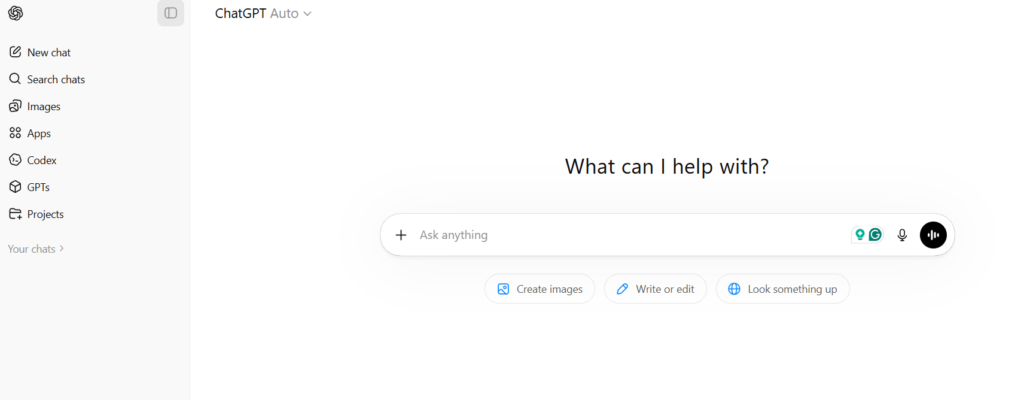
ChatGPT is one of the most powerful AI research assistants available in 2026. It helps users understand complex topics, generate research questions, summarize academic content, and assist with methodology planning. While it does not access real-time academic databases, it is an excellent starting point for building foundational knowledge before deeper research.
Perplexity AI – Best AI Search Engine for Research
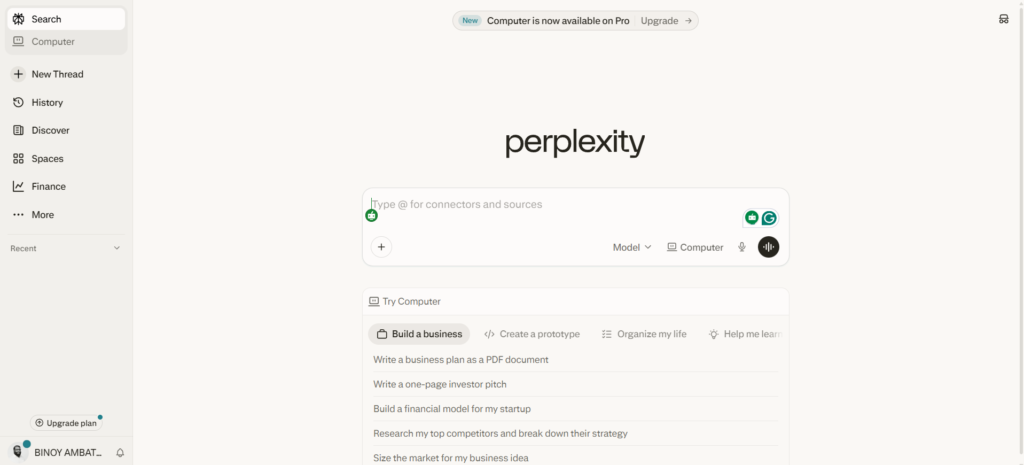
Perplexity AI is a research-focused AI search engine that provides real-time answers with source citations. It combines multiple sources into a single, easy-to-understand response, making it ideal for quickly validating information and discovering credible references.
Elicit – Best AI Tool for Academic Papers
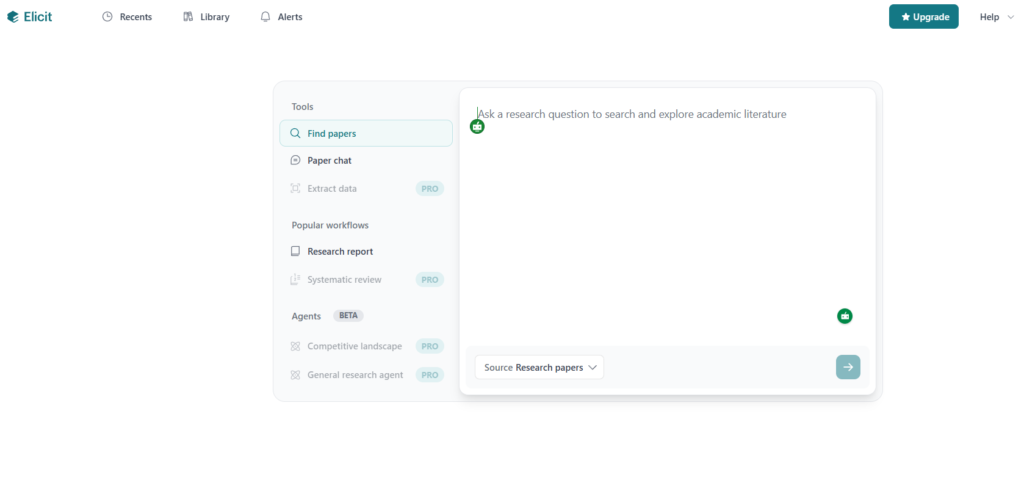
Elicit is designed specifically for academic research. It helps users find relevant papers, extract key findings, and compare studies side by side. This makes literature reviews significantly faster and more structured.
Consensus – Best AI Tool for Scientific Research
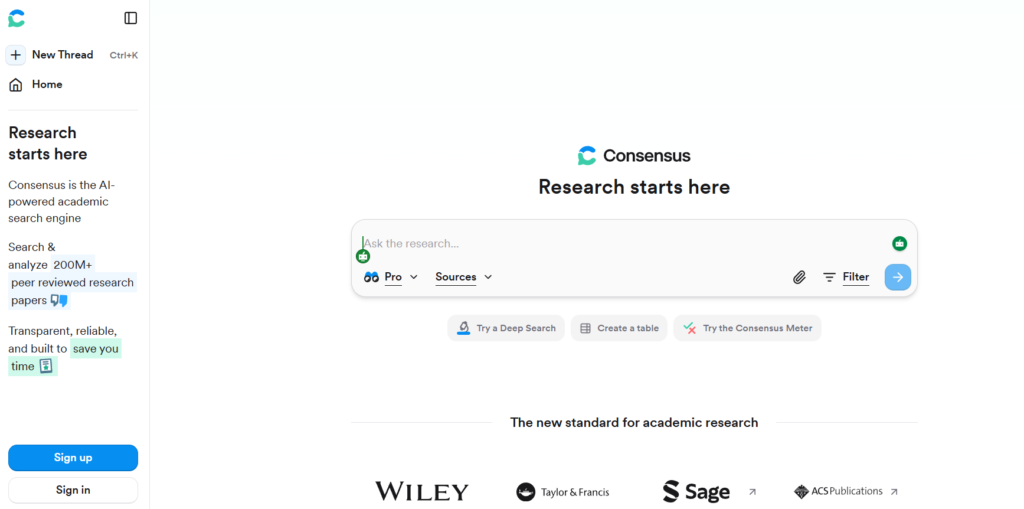
Consensus focuses on evidence-based answers from peer-reviewed research. It shows whether studies agree or disagree on a topic, helping researchers quickly understand the strength of scientific evidence.
Scite – Best AI Tool for Citation Analysis
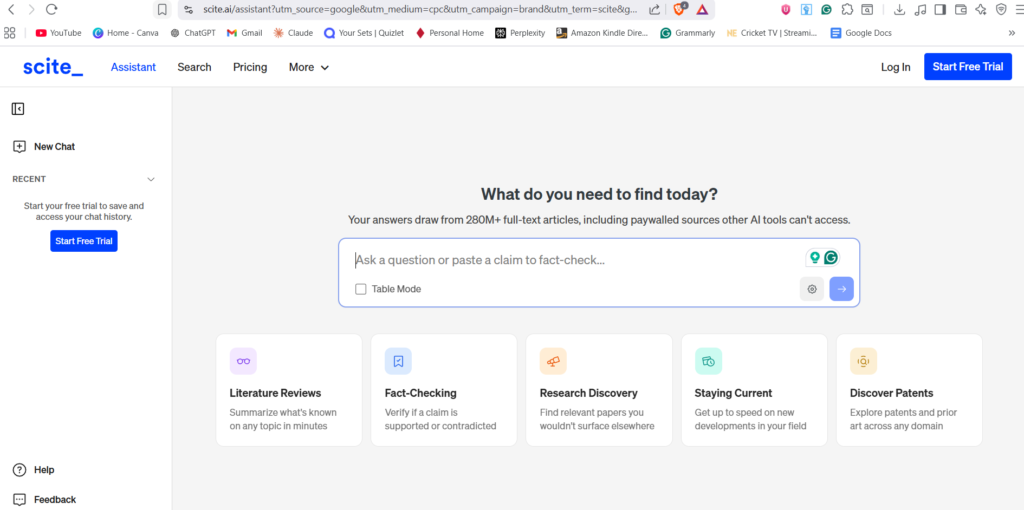
Scite analyzes how research papers cite each other, showing whether citations support or contradict findings. This helps researchers evaluate the credibility and impact of academic sources more effectively.
Research Rabbit – Best AI Tool for Literature Discovery
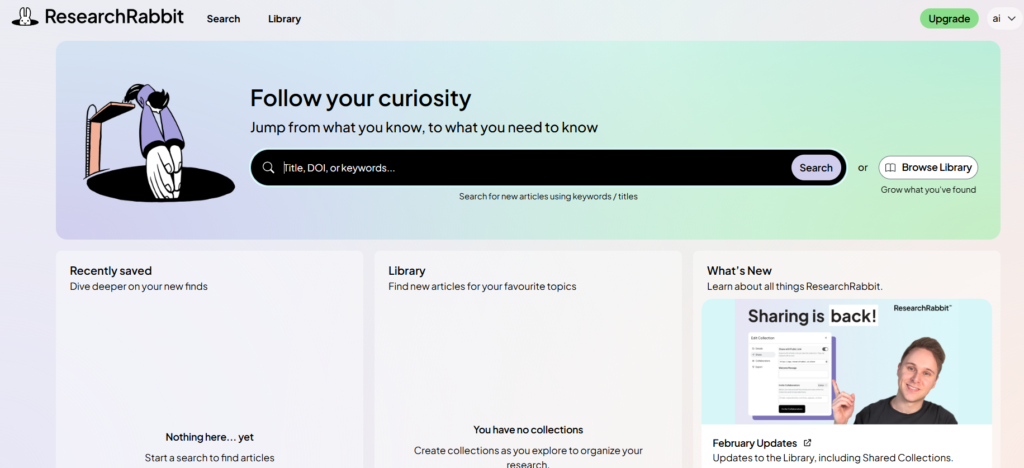
Research Rabbit helps users discover academic papers through visual maps and citation networks. It is especially useful for exploring related research and identifying important studies in a field.
Notion AI – Best AI Tool for Research Organisation
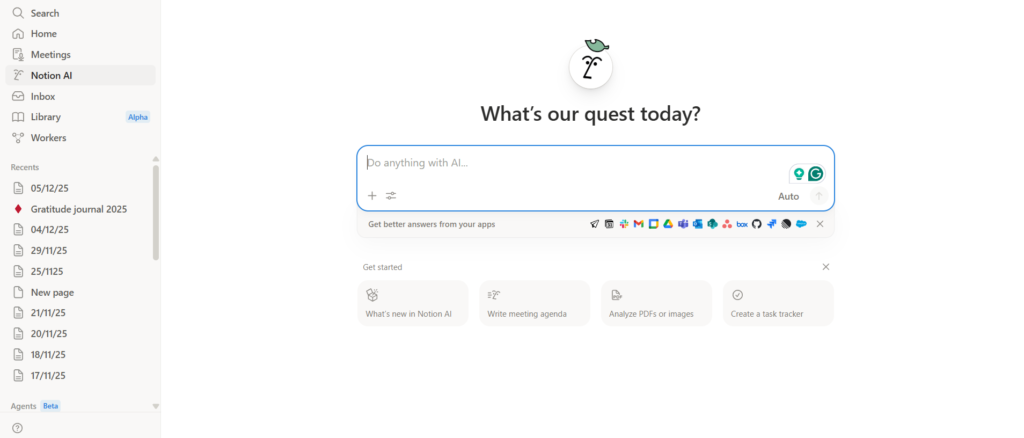
Notion AI helps organize research notes, summaries, and projects in one place. It can automatically structure information, generate summaries, and improve workflow efficiency for researchers.
Grammarly – Best AI Writing Assistant for Research Papers
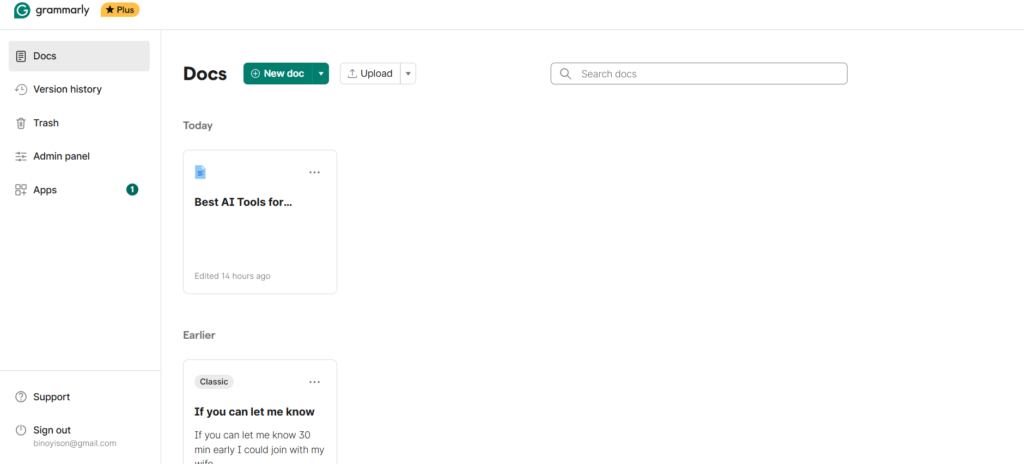
Grammarly improves the clarity, grammar, and tone of research writing. It is widely used to refine academic papers, ensuring they are professional, readable, and free from errors.