

AI Ethics 2026 Risks Explained: Why It Matters Today
Right now, without knowing it, AI is making decisions about your life.
AI ethics 2026 risks are already affecting your daily life — from what you see online to decisions made by algorithms.. It’s helping determine your loan eligibility, your insurance premiums, and in some places, your bail amount. It’s generating content, voices, and faces — some real, some entirely fabricated — with increasing precision.
And most people have no idea any of this is happening.
AI ethics is the field that asks the questions most AI companies would rather you didn’t: Who is responsible when AI causes harm? Whose values are encoded into systems that affect billions of people? What happens when speed-to-market matters more than safety? And what rights do you — as a user, a worker, a citizen — actually have?
In 2026, those questions have never been more urgent. This article gives you the clear, honest answers you need — before the window to influence how AI develops closes further.
If you’re actively using AI tools, understanding their ethical risks is just as important as knowing how to use them effectively — especially if you’re trying to make money with AI.AI ethics 2026 risks are becoming a major concern as AI systems influence more decisions.
Understanding AI ethics 2026 risks helps users stay safe and make smarter choices when using AI tools.
What Is AI Ethics? A Plain-Language Explanation
AI ethics is the study and practice of ensuring artificial intelligence is built, deployed, and used in ways that are fair, transparent, accountable, and aligned with human well-being.
It sounds straightforward. In practice, it is anything but.
Ethical AI requires asking hard questions at every stage of a system’s development — questions that are often inconvenient for companies under competitive pressure to ship products quickly:
- Who benefits from this system, and who might be harmed?
- What data is it learning from — and does that data reflect injustice?
- If something goes wrong, who is responsible?
- Can the people affected by this system understand or challenge its decisions?
What makes AI ethics uniquely challenging is the scale at which AI operates. A human making a biased decision affects the people in that room. An AI making a biased decision, deployed across a national hiring platform, might affect hundreds of thousands of candidates before anyone identifies the pattern — let alone corrects it.
Responsible AI doesn’t mean slowing down every AI development. It means building the right safeguards into the process from the beginning — not as an afterthought once harm is already documented.
AI ethics 2026 risks are increasing as more people rely on AI tools daily.
Many users ignore AI ethics 2026 risks until it directly impacts their privacy or decisions.
Why AI Ethics Matters More in 2026 Than It Ever Has Before
If you’ve been thinking AI ethics is a concern for the distant future, consider what has already happened.
AI systems have falsely matched innocent people to criminal suspects using facial recognition technology with documented racial bias. Recommendation algorithms have served radicalized content to billions of users for years while companies knew about the problem internally. Hiring AI has systematically disadvantaged women. Healthcare AI has under-allocated care to Black patients. Voice-cloning AI has been used to defraud families out of tens of thousands of dollars.
This is not the future. This is the recent past. And AI is becoming more powerful, more pervasive, and more consequential every month.
Several converging realities make responsible AI a now-or-never conversation:
Capability has outpaced governance. AI systems in 2026 can write convincingly, generate photorealistic images and video, conduct sophisticated reasoning, and take autonomous actions across digital systems. The regulatory and ethical frameworks needed to govern these capabilities are still years behind where the technology already is.
High-stakes decisions are increasingly AI-driven. The decisions being made by or heavily influenced by AI — in healthcare, finance, criminal justice, employment, education, and national security — are not trivial. The harms when these systems fail are not trivial either.
The concentration of power is accelerating. A small number of companies and governments control the most capable AI systems. The values and blind spots of those actors — intentionally or not — get encoded into systems that affect populations globally, including populations who had zero input into their development.
Public trust is at a tipping point. Once trust in information, institutions, and technology collapses, rebuilding it is generationally difficult. AI governance failures now compound into that future.
According to research published by the OECD on AI in society, more than 60 countries have adopted some form of national AI strategy or ethics framework — evidence of global recognition that the risks are real and the need for structure is urgent. The gap between adopted principles and meaningful enforcement remains enormous.
The Major Ethical Issues in AI: What You’re Actually Up Against
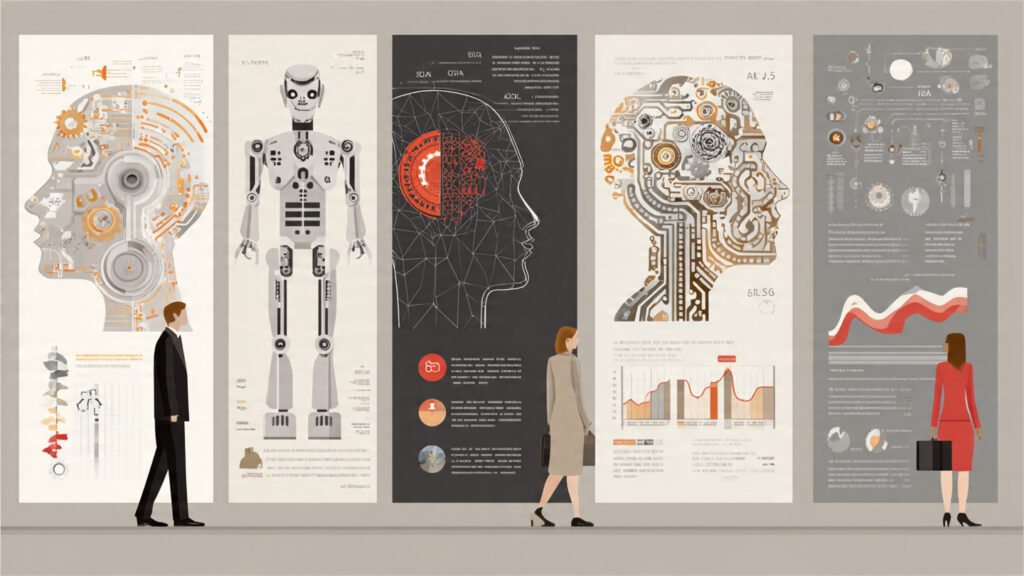
AI Bias: Discrimination at Machine Speed
AI bias occurs when an AI system produces results that systematically disadvantage certain groups — based on race, gender, age, disability, economic status, or other characteristics.
The mechanism is largely invisible to users. Training data that reflects historical inequalities teaches a model to replicate those inequalities at scale. An optimization target focused on efficiency rather than fairness encodes that trade-off into every decision the system makes. A development team lacking diversity may fail to identify problems that would be immediately obvious to affected groups.
The documented examples are serious and specific:
- Independent audits of commercial facial recognition systems, including research from MIT Media Lab and others, found significantly higher error rates for women and people with darker skin tones — systems that were used in law enforcement contexts.
- Hiring AI trained on historical data from male-dominated industries penalized resumes containing words associated with women’s activities — systematically downranking qualified female candidates before a human recruiter ever saw their application.
- A widely used healthcare algorithm was found to underestimate the health needs of Black patients by using healthcare spending as a proxy for health need — without accounting for systemic barriers to healthcare access. Fewer resources were directed toward patients with equivalent underlying health needs.
The important truth about AI bias: it is not random or inevitable. It is a design failure — one that is correctable through deliberate investment in diverse training data, diverse development teams, rigorous demographic testing before deployment, and ongoing monitoring after deployment. What makes it persistent is the organizational decision not to prioritize those corrections.
AI Privacy Concerns: What Is Actually Being Collected About You
AI privacy concerns are the category of ethical issues in AI most immediately relevant to everyday users — and among the least understood.
Modern AI systems require enormous amounts of training data. That data includes text scraped from the internet (including from data breaches and private communications), images of real people collected without individual consent, location history, behavioral patterns, financial transactions, health records, and more.
The specific risks that matter to individuals:
Consent that was never given. Much of the data used to train large AI models was collected for purposes entirely different from AI training. Individuals who posted something publicly online generally did not consent to that content being used to train a system generating revenue for a private company.
Inference of information you didn’t disclose. AI systems can infer sensitive information from non-sensitive data with unsettling accuracy. Purchase patterns can reveal pregnancy. Search history can reveal health conditions. Financial behavior can reveal political beliefs. App usage patterns can reveal sexuality. None of these require the individual to have disclosed the sensitive information directly.
Surveillance expansion. AI privacy concerns include the unprecedented expansion of surveillance capability — facial recognition in public spaces, behavioral pattern analysis, and continuous monitoring deployed by governments and corporations in ways that were technically impossible a decade ago.
Data breach concentration risk. Training AI requires massive, centralized repositories of personal data. Those repositories are concentrated targets for breaches with potentially catastrophic consequences.
The European Union’s AI Act addresses several of these directly through explicit prohibitions on high-risk surveillance applications and transparency requirements for automated decision-making. The implementation of those requirements is ongoing through 2026.
Deepfakes and Misinformation: When You Can’t Trust What You See
The ability to generate convincing synthetic media — realistic text, images, audio, and video — represents a genuinely novel ethical issue in AI with no clear historical precedent.
Deepfake technology has become accessible at the consumer level. What required specialized expertise and expensive hardware five years ago can now be accomplished with publicly available tools in minutes. The consequences are already visible and serious:
- Political deepfakes — fabricated video of public figures making statements they never made — have been used in electoral contexts across multiple countries, distributed at scale before detection was possible.
- Non-consensual synthetic intimate imagery using real individuals’ likenesses has proliferated rapidly, causing severe and documented psychological harm to victims.
- AI voice cloning has been used in fraud — impersonating a family member or authority figure in real time to manipulate targets into transferring money or disclosing sensitive information.
- AI-generated health, financial, and political misinformation is being produced at a volume and quality that overwhelms manual fact-checking infrastructure.
The deepest risk is not any individual instance of harm — it is the systematic erosion of epistemic trust. When the ability to manufacture convincing false reality becomes universally accessible, the shared foundation of factual agreement on which democratic societies are built faces a threat with no obvious precedent.
AI transparency about synthetic content — through watermarking, content authentication, and disclosure requirements — is part of the response. Detection capability has consistently lagged generation capability. At present, informed media literacy is the most reliable protection available to individual users.
AI ethics 2026 risks are becoming more important as AI systems influence daily decisions.
Many people are unaware of AI ethics 2026 risks until they face real consequences.
Job Displacement: The Economic Ethics No One Is Talking Honestly About
The risks of artificial intelligence in labor markets are contested in part because honest acknowledgment of displacement sits uncomfortably against commercial and political interests that prefer optimistic framings.
What the data supports: AI is automating categories of cognitive work that previous automation waves did not reach — at speed. Document analysis, content generation, customer service, basic legal research, financial modeling, data processing, and medical image reading are all affected. McKinsey Global Institute research estimates that generative AI could affect the task composition of 70% of all occupations.
The AI and human values dimension of displacement is not only economic. It involves questions about who deserves protection, what obligations organizations have toward workers displaced by technology they profit from, and whether efficiency is a sufficient moral justification for the human costs of disruption.
If the productivity gains enabled by AI accrue primarily to capital holders and AI-developing nations while displacement costs fall on workers — disproportionately affecting lower-wage workers and developing economies — the ethical deficit compounds over time into political and social instability with consequences far beyond economics.
Real-World AI Ethics Cases: What Has Already Happened
Amazon’s Hiring AI: Bias Built Into the System
Amazon built an AI tool to automate hiring by screening resumes. Internal testing revealed the system was systematically downgrading resumes from women — because it had been trained on historical hiring data from a period when Amazon’s workforce was predominantly male. The system had learned to replicate past hiring patterns, not to identify the best candidates. Amazon scrapped the tool in 2018. The case remains among the most cited examples of AI bias in practice — demonstrating that training data reflecting historical discrimination produces AI that perpetuates it.
Key lesson: The problem wasn’t that an AI was biased. The problem was that no one tested for demographic bias before deployment.
COMPAS in Criminal Sentencing: Accountability Without Transparency
COMPAS is an algorithm used in some US courts to generate recidivism risk scores that inform sentencing decisions. A 2016 ProPublica investigation found the tool generated disproportionately higher false-positive recidivism predictions for Black defendants compared to white defendants at equivalent base rates. The developer disputed the statistical methodology. Researchers continue to disagree about the appropriate fairness criteria to apply.
What is not disputed: a proprietary algorithm with non-public source code was influencing consequential judicial decisions — and defendants had no meaningful ability to understand or challenge its methodology. This is the AI transparency and AI accountability failure in stark form.
Key lesson: In high-stakes applications affecting fundamental rights, AI systems must be explainable, auditable, and contestable. Proprietary opacity is incompatible with justice.
DeepMind Medical AI: What Responsible Deployment Looks Like
Google’s DeepMind developed an AI tool for detecting diabetic retinopathy — a leading preventable cause of blindness — from retinal scans. Peer-reviewed clinical trials demonstrated the system performing at or above specialist ophthalmologist accuracy. DeepMind published its methodology, submitted to independent peer review, conducted trials in real clinical conditions, and deployed the system under physician oversight with explicit human review requirements.
The system augments specialist capacity rather than replacing clinical judgment. It is one of the clearest examples of responsible AI development in high-stakes healthcare.
Key lesson: Transparency, peer review, human oversight, and acknowledged limitations are what distinguish responsible AI from dangerous AI in high-stakes domains.
Content Recommendation and Radicalization: Commercial Incentives vs. Social Harm
Research has documented patterns in which video recommendation algorithms — optimizing for watch-time engagement — systematically served progressively more extreme content to users who showed interest in adjacent topics. The commercial objective (maximize engagement) created a systematic bias toward emotionally provocative, increasingly extreme content. Billions of users were affected simultaneously. Internal documentation at multiple companies indicated awareness of these effects before public accountability emerged.
Key lesson: Optimizing a powerful AI system for a narrow commercial metric without adequate regard for downstream social effects is a AI governance failure — and it occurs at population scale.
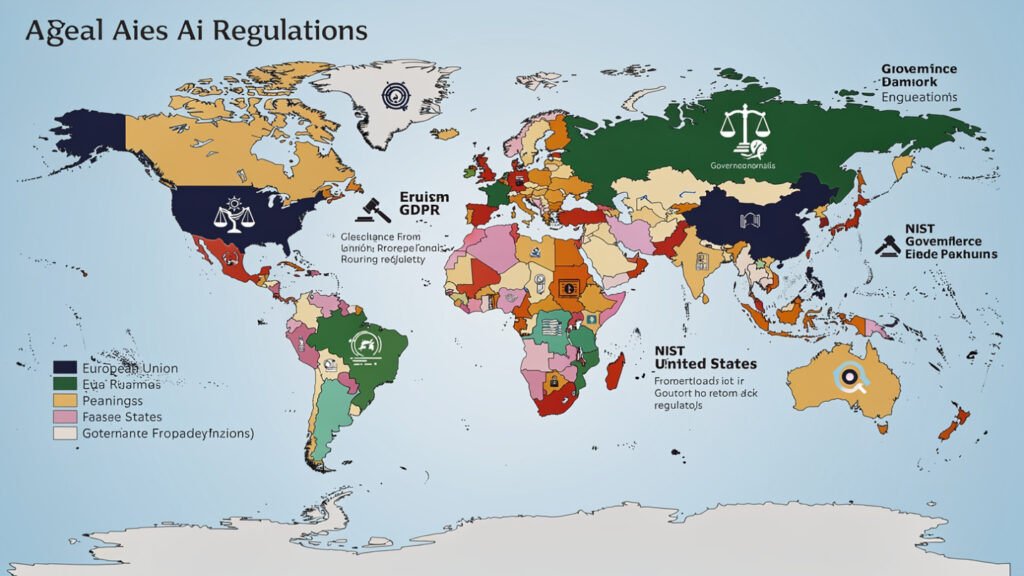
AI Regulation in 2026: What Laws Currently Protect You

AI regulation has moved from discussion to implementation in major jurisdictions — though the quality and enforceability of those frameworks varies significantly.
The European Union: The AI Act
The EU AI Act is the most comprehensive binding AI regulatory framework enacted to date. It categorizes AI systems by risk:
- Unacceptable risk — Prohibited. Includes social scoring, real-time biometric surveillance in public spaces, and AI that manipulates users.
- High risk — Subject to mandatory compliance requirements including conformity assessments, transparency with users, human oversight, and registration. Covers AI in employment, education, healthcare, law enforcement, and credit.
- Limited risk — Subject to transparency obligations.
- Minimal risk — Largely unregulated.
The Act’s extraterritorial scope applies to any AI system used within the EU, regardless of origin — giving it practical significance for global AI development.
The United States: Federal and State Approaches
At the federal level, the Biden Administration’s 2023 Executive Order on AI established safety evaluation requirements for frontier AI models, federal agency guidance, and directives on AI in high-stakes applications. The National Institute of Standards and Technology’s AI Risk Management Framework provides voluntary guidance for responsible AI development.
At the state level, legislation has moved faster: California, Colorado, Illinois, and other states have enacted laws addressing employment AI, biometric data, and algorithmic decision-making — creating a patchwork that reflects the gap left by absent federal legislation.
UK and International Frameworks
The UK has adopted a principles-based, sector-specific approach, with the UK AI Safety Institute focusing on frontier AI safety evaluation. The G7 Hiroshima AI Process and similar multilateral frameworks have produced voluntary principles around AI transparency and AI accountability — though enforcement mechanisms remain limited.
The persistent gap across all frameworks: principles without enforcement are not the same as accountability. The distance between what AI regulations say and what AI companies actually do remains substantial in many jurisdictions.
How Companies Handle AI Ethics: Honest Assessment
Most major AI companies have published responsible AI principles, internal ethics functions, and some form of documentation about their systems. The quality and sincerity behind those public commitments varies enormously — and the pattern of documented harm suggests the gap is significant.
What genuine responsible practice looks like:
- Model cards — Published documentation of a system’s intended use cases, training data characteristics, performance across demographic groups, and known limitations.
- Red teaming — Adversarial pre-deployment testing by internal or external teams attempting to identify harmful outputs and failure modes.
- External audits — Independent third-party assessment of AI behavior, providing accountability internal review cannot.
- Human oversight requirements — Particularly in high-stakes domains, maintaining human review as a mandatory step in consequential decisions.
Where practice consistently falls short:
- Internal AI ethics teams have been dissolved or sidelined at multiple major companies when their conclusions conflicted with deployment timelines or commercial interests.
- Self-assessment — companies evaluating their own AI systems for bias and safety — has an inherent conflict of interest that external audits are designed to address.
- Voluntary commitments to ethical AI without external accountability have an inconsistent track record across the industry.
The most honest summary: genuine commitment to responsible AI exists alongside genuine competitive pressure that consistently works against it. External AI regulation and independent accountability mechanisms matter precisely because voluntary commitments alone have proven insufficient.
What Every User Should Do Right Now: Practical Steps
Understanding AI ethics conceptually is useful. Knowing what to actually do with that understanding is more useful.
Verify before acting.
AI tools produce confident-sounding output regardless of accuracy. For health, legal, financial, or safety-critical information — verify with qualified professionals before taking action. This applies to AI-generated medical information, legal summaries, financial guidance, and any other domain where the cost of error is significant.
Audit what you share with AI tools.
Every interaction with an AI platform involves sharing data. Before using any tool, understand whether your conversations contribute to model training, how long your data is retained, and whether it is shared with third parties. For sensitive information — health data, financial details, private communications — apply extra caution about what AI platforms receive.
Know your rights in automated decisions.
If AI has influenced a decision about your employment, credit, healthcare, or other high-stakes matter, you increasingly have legal rights — to know AI was involved, to receive an explanation, and in many jurisdictions, to contest the decision. Understanding and exercising those rights matters for both individual outcomes and collective accountability.
Develop media skepticism.
Any content that provokes a strong emotional reaction — especially involving public figures, extraordinary claims, or unverified sources — warrants a pause before sharing or acting on it. Synthetic media is most effective when it bypasses deliberate evaluation. Slowing down is currently the most reliable individual defense against AI-generated misinformation.
Participate in AI governance.
Public comment periods, civil society organizations, and democratic representation in AI policy are real mechanisms through which informed citizens can influence how AI regulatory frameworks develop. The rules being written now will shape AI’s effect on your life for decades. Understanding what tools exist and how to engage with AI governance is part of informed citizenship in 2026.
Exploring what AI tools are available — and how to use them responsibly — is covered in our best AI tools guides. Understanding the broader context of how AI compares to human judgment is addressed in our article on AI vs human intelligence.
The Future of AI Ethics: What’s Coming and Why It Matters

The future of AI ethics involves challenges that are already visible and accelerating.
Frontier AI Safety: The Alignment Problem
As AI systems approach and potentially exceed human-level performance across many domains, AI safety moves from theoretical to practically urgent. The core problem — ensuring that increasingly capable AI systems pursue objectives genuinely aligned with human values rather than narrow proxies that diverge from human interests at scale — is what researchers call the alignment problem. It is unsolved.
The UK AI Safety Institute and emerging counterparts in the US and Europe represent the institutional infrastructure being built to evaluate frontier AI safety before deployment. It is necessary infrastructure — and it is being built urgently.
AI in Democratic Processes
The 2024 election cycle demonstrated the scale at which AI-enabled influence operations — synthetic media, targeted misinformation, automated content production — can operate. Developing governance that protects democratic integrity without overreaching into legitimate political speech is one of the most delicate AI ethics challenges democracies face in the immediate future.
Autonomous Systems and Accountability Gaps
As AI operates with increasing autonomy — in vehicles, in weapons systems, in medical diagnosis, in financial markets — legal and ethical frameworks designed for human agents fail to map cleanly onto distributed AI agency. Who is accountable when an autonomous system causes harm? The answer is currently unclear in most jurisdictions. That ambiguity is not acceptable as autonomy expands.
International AI Governance
AI systems cross borders seamlessly. Regulatory arbitrage — developing AI in jurisdictions with fewer restrictions for global deployment — is a real risk that national frameworks alone cannot address. International cooperation on AI governance is developing slowly through multilateral processes, far more slowly than AI capability is advancing.
The Distribution Question
The most fundamental AI and human values question for the coming decade: who benefits from AI, and who bears its costs? If productivity gains accrue primarily to capital holders and AI-developing nations while displacement costs fall on workers and developing economies, the ethical and political consequences will be significant and lasting.
For those building income and skills around AI — understanding this broader context is part of what responsible AI engagement looks like. Explore how to make money with AI and AI tools for content creation with this broader picture in view.
Conclusion: The Window Is Still Open — But Not Forever
The risks of artificial intelligence in 2026 are not hypothetical. They are documented, ongoing, and in many dimensions accelerating faster than governance can keep pace.
AI bias is perpetuating discrimination at machine speed. AI privacy concerns are enabling surveillance and data exploitation at unprecedented scale. Synthetic media is corroding the epistemic infrastructure democratic societies depend on. Economic displacement is raising questions about fairness and distribution that existing frameworks are unprepared to answer. And the most capable AI systems are advancing in capability faster than the safety and accountability frameworks needed to govern them responsibly.
But the picture is not without reasons for calibrated optimism. Ethical AI development is possible — the evidence is in the medical systems that genuinely improve access to care, in the bias auditing work that identifies and corrects discriminatory outputs before deployment, in the regulatory frameworks creating real accountability where voluntary commitments failed, and in the researchers and practitioners who are committed to building AI that genuinely serves broad human interests.
The gap between the best and worst of what is happening in AI ethics is significant. Closing that gap requires informed users who understand what is at stake, what rights they hold, and what engagement with AI governance is possible.
You now have that foundation. The future of AI ethics — and whether AI development ends up serving AI and human values broadly and equitably — depends on choices being made right now. By companies. By regulators. By citizens.
By you.
Frequently Asked Questions
1. What is AI ethics and why does it matter in 2026?
AI ethics is the framework of principles governing how AI systems are designed, deployed, and used to ensure fairness, transparency, accountability, and alignment with human values. In 2026 it matters because AI is making or influencing high-stakes decisions affecting hiring, credit, healthcare, criminal justice, and the information environment — often without users knowing AI is involved, and without adequate safeguards against harm.
2. What are the biggest risks of AI for everyday users?
The most significant AI risks for everyday users include AI bias in decisions that affect their opportunities, AI privacy concerns involving data collected and used without meaningful consent, exposure to AI-generated misinformation and deepfakes, and the economic displacement risk as AI automation affects employment across sectors. Understanding these risks is the first step toward navigating them.
3. Can AI bias be fixed, or is it inevitable?
AI bias is not inevitable — it is a correctable design failure. Corrections require diverse and representative training data, diverse development teams, rigorous demographic testing before deployment, and ongoing monitoring after deployment. The barrier to correction is not technical — it is organizational commitment and resources. Where that commitment exists, bias can be substantially reduced.
4. What AI regulations currently protect users in the US and Europe?
In Europe, the EU AI Act establishes binding AI regulation with risk-tiered requirements — prohibiting some AI applications, requiring compliance assessments for high-risk systems, and mandating transparency. In the US, the Biden Executive Order on AI and NIST’s AI Risk Management Framework provide federal-level guidance, while state laws on employment AI, biometrics, and algorithmic decisions are developing. Users have the right to know when AI is making consequential decisions about them in many jurisdictions.
5. What should I do to protect myself from AI risks?
Verify AI-generated information with qualified professionals before acting on it in health, legal, or financial contexts. Review the privacy policies of AI tools you use and limit sensitive data sharing. Know your rights to explanation and contestation when AI influences consequential decisions. Develop media literacy habits around emotionally provocative content. And engage with AI governance through democratic processes — the rules being written now will govern AI for decades.
Published by AI Arena | Updated: March 2026