
Introduction: The Word Everyone Is Using but Few People Actually Understand
Artificial intelligence is mentioned in every news headline, every tech product, and every conversation about the future of work.
But if someone asked you right now — clearly, in plain English — what is artificial intelligence and how it actually works, would you know what to say? Most people would not. And that is completely understandable. The topic has been surrounded by jargon, science fiction, and hype for so long that the simple, practical explanation has gotten lost.
What is artificial intelligence is one of the most important concepts to understand in today’s digital world.
This guide fixes that.
By the end of this article, you will understand what artificial intelligence actually is, how it works, what types exist, where you are already encountering it every day without realising it, and how to start using it to your advantage in 2026.
No technical background required. No jargon. Just clear, honest explanations.
What Is Artificial Intelligence?
Artificial intelligence (AI) is the ability of a computer or software system to perform tasks that normally require human intelligence — such as understanding language, recognising images, making decisions, and learning from experience.
The key word is learning. Traditional computer programmes follow a fixed set of instructions. AI systems learn from data, improving their performance over time through experience rather than explicit reprogramming.
In short: AI is software that thinks, learns, and adapts — rather than simply following a rigid script.
Artificial Intelligence Explained in Simple Words
Imagine you are teaching a child to recognise a dog. You do not give them a rulebook listing every possible dog characteristic. You show them hundreds of pictures. After seeing enough examples, they start recognising dogs on their own — even breeds they have never seen before.
AI learns in a very similar way.
You feed an AI system thousands (or millions) of examples. It finds patterns in those examples. Over time, it gets better at making correct predictions, classifications, or decisions based on new data it has never seen before.
That is artificial intelligence explained at its core — pattern recognition at enormous scale, happening faster than any human brain could manage.
A few everyday analogies help:
- Autocomplete on your phone — AI has learned from billions of messages to predict what word you are likely to type next
- Spam filter in your email — AI has analysed millions of spam emails to recognise new ones it has never seen before
- Voice assistants like Siri or Alexa — AI has processed millions of voice samples to understand what you are saying and respond appropriately
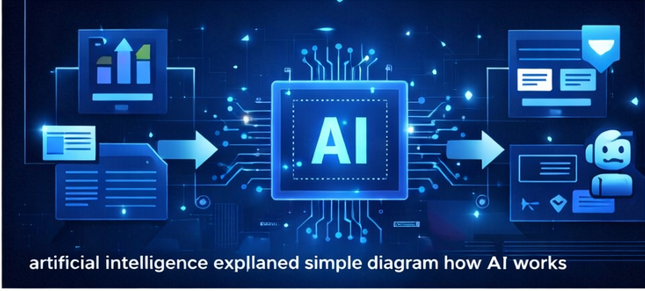
[Insert image: simple diagram showing data going in and decisions coming out of an AI system]
ALT text: artificial intelligence explained simple diagram how AI learns from data
How Artificial Intelligence Works
Understanding how AI works does not require a computer science degree. The basic process involves three components: data, algorithms, and training.
Data is the raw material. AI learns from examples — text, images, numbers, speech, behaviour patterns. The more relevant, high-quality data an AI system has access to, the better it becomes at its task.
Algorithms are the instructions for how the AI should process that data and find patterns. Think of an algorithm as a recipe — it tells the system what steps to follow to turn raw data into useful output.
Training is the learning process. During training, the AI is shown large amounts of data and gradually adjusts its internal settings (called parameters) until it can make accurate predictions or decisions reliably. This is called machine learning — the AI is literally learning from experience, improving with each iteration.
A simple example:
An AI trained to detect fraudulent bank transactions is shown millions of real transactions — both legitimate and fraudulent. Over thousands of training iterations, it learns the subtle patterns that distinguish the two. When a new transaction appears, it applies those patterns to assess whether it looks suspicious.
That is the fundamental mechanism behind most AI systems operating today.
Types of Artificial Intelligence
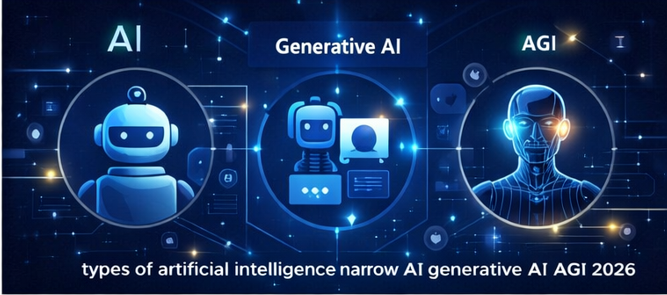
Not all AI is the same. In 2026, there are three main categories worth understanding.
[Insert image: three types of AI illustrated - narrow AI, generative AI, AGI]
ALT text: types of artificial intelligence narrow AI generative AI AGI explained 2026
H3: Narrow AI — The AI You Already Use Every Day
Narrow AI (also called weak AI) is designed to do one specific task very well. It cannot do anything outside its specialisation.
Every AI tool you interact with today is narrow AI:
- Netflix recommending films based on your watch history
- Google Maps calculating the fastest route
- Your bank’s fraud detection system
- Spotify creating a playlist based on your listening habits
- Facial recognition unlocking your phone
Narrow AI is extraordinarily useful. It powers almost all practical AI applications in 2026. But it cannot transfer its knowledge between domains — the AI that recommends films cannot also navigate a car or detect fraud.
Generative AI — The New Generation Creating Content
Generative AI is a type of narrow AI specifically designed to create content — text, images, audio, video, and code — based on what it has learned from vast amounts of existing content.
This is the category that has captured public attention most dramatically over the past three years.
Generative AI explained simply: It is AI that generates new things rather than just recognising or classifying existing things.
Examples of generative AI you may already use:
- ChatGPT — generates written responses, explanations, and content
- DALL-E and Midjourney — generate images from text descriptions
- GitHub Copilot — generates code suggestions for software developers
- ElevenLabs — generates realistic AI voiceovers from text
Generative AI is the foundation of most AI tools available for personal and professional use in 2026 — and it is the category most relevant to the practical applications in this guide.
Artificial General Intelligence (AGI) — Still a Concept
AGI refers to an AI system capable of performing any intellectual task that a human can — across any domain, at human level or above.
No AGI system currently exists. Today’s AI, however impressive in specific tasks, cannot transfer knowledge across domains the way a human can. A chess-playing AI cannot also write a poem or drive a car.
Whether AGI will be achieved — and when — is one of the most debated questions in technology. Some researchers believe it is decades away. Others think it may be closer. What everyone agrees on is that it does not exist yet.
Real-Life Examples of AI in Daily Life
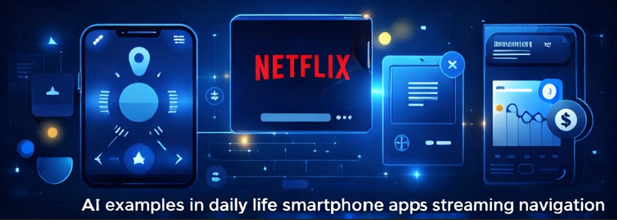
AI examples in daily life are everywhere — most people simply do not notice them because they have become so seamlessly embedded into everyday technology.
[Insert image: collage of AI in daily life - phone, streaming, GPS, shopping]
ALT text: AI examples in daily life smartphones streaming navigation shopping 2026
On your smartphone:
Face ID uses AI to recognise your face and unlock your phone. Autocomplete uses AI to predict your next word. Your camera uses AI to detect faces, adjust lighting, and identify the best moment to take a photo.
On streaming platforms:
Netflix, YouTube, and Spotify use AI to analyse what you watch, how long you watch it, and what you skip — then recommend content personalised specifically to your behaviour. The reason two people on the same platform see completely different content is AI.
When you shop online:
Amazon uses AI to predict what you are likely to buy next, show you relevant ads based on browsing history, and flag product reviews that appear fake. The “customers also bought” recommendations are AI-generated in real time.
In finance:
Your bank uses AI to detect unusual transactions and flag potential fraud. Insurance companies use AI to calculate risk. Budgeting apps use AI to categorise spending and identify patterns. If you are curious how these tools work in practice, our guide on AI tools for budgeting covers the best AI finance apps available in 2026.
In navigation:
Google Maps and Waze use AI to analyse millions of real-time data points — traffic, incidents, road closures, historical patterns — and calculate the fastest route dynamically, updating as conditions change.
In healthcare:
AI systems analyse medical images to detect cancers and diseases at earlier stages than human radiologists can achieve manually. AI is being used to accelerate drug discovery, predict patient outcomes, and personalise treatment recommendations.
The list extends into almost every industry and every corner of daily life. What was exceptional in 2015 is simply infrastructure in 2026.
Why Artificial Intelligence Matters in 2026
The reason what is artificial intelligence has become one of the most searched questions in the world is not abstract curiosity. It is practical concern and practical opportunity.
For workers and professionals: AI is automating significant portions of many job functions — not replacing jobs wholesale, but changing what those jobs require. Understanding AI is becoming a baseline professional skill in the same way computer literacy was 30 years ago.
For business owners and entrepreneurs: AI tools reduce the cost and time of producing content, analysing data, managing customer communications, and building software. Businesses using AI efficiently are operating at an advantage over those that are not.
For everyday individuals: AI tools for productivity, finance, learning, and creativity are available to anyone with an internet connection — often for free. The gap between what was previously available only to large organisations and what any individual can now access has closed dramatically.
For society more broadly: AI is raising significant questions about privacy, bias, employment, security, and the distribution of economic benefit. Understanding AI is becoming a civic literacy issue — not just a professional one.
The people who understand how AI works — even at a basic level — are better positioned to use it effectively, evaluate its risks honestly, and participate meaningfully in conversations about how it should be governed.
How Beginners Can Start Using AI Today
You do not need a technical background to start using AI tools productively. Most of the best applications in 2026 are designed for non-technical users and require nothing more than an internet connection and a browser.
Here are the simplest starting points for AI beginners:
- ChatGPT (free) — Ask it anything. Use it to draft emails, explain concepts, generate ideas, write plans, or summarise complex documents. The conversational format requires no learning curve.
- Google Gemini (free) — Integrated into Google Docs, Gmail, and Search. If you already use Google tools, Gemini adds AI capability without changing your workflow.
- Grammarly (free) — Improves your writing automatically as you type. Works in every browser and platform you already use.
- Canva AI (free) — Creates professional images, presentations, and visual content from simple text descriptions.
The best approach is to choose one tool, use it on a real task this week, and experience what it can do before exploring further. The practical understanding you gain from one real session is worth more than hours of reading about AI theoretically.
For a comprehensive review of the most useful tools across every category, explore our guide on best AI tools — it covers everything from writing assistants to productivity tools to creative applications.
Limitations of Artificial Intelligence
A balanced understanding of what is artificial intelligence requires being honest about what it cannot do — because the limitations are as important as the capabilities.
AI can be wrong — confidently. Large language models like ChatGPT can state incorrect information with complete confidence. They are designed to produce plausible-sounding responses, not guaranteed accurate ones. Always verify factual claims from AI tools against authoritative sources.
AI has no understanding. Despite generating text that sounds intelligent, current AI does not understand the content it produces in the way humans do. It processes patterns in data. The appearance of understanding is a product of how AI was trained, not genuine comprehension.
AI reflects its training data. If the data an AI was trained on contains biases — historical, cultural, or demographic — the AI will reproduce those biases in its outputs. This is an active area of research and a genuine concern in high-stakes applications.
AI cannot replace human judgment. In contexts requiring ethical reasoning, cultural sensitivity, professional accountability, and the integration of lived experience — legal decisions, medical diagnoses, financial advice, creative authorship — AI is a tool to support human judgment, not replace it.
AI raises real privacy questions. Most AI tools process data through external servers. Data you input into AI tools may be used for model training. Understanding the data policies of any tool you use — particularly with sensitive personal or business information — matters.
[Insert image: person reviewing AI output critically on a computer]
ALT text: limitations of artificial intelligence human reviewing AI content carefully
Future of Artificial Intelligence
The future of artificial intelligence is one of the most actively discussed topics in technology, economics, and public policy.
Several developments are shaping where AI heads from 2026 onward.
Multimodal AI is becoming standard. AI systems are increasingly able to process and generate across multiple formats simultaneously — text, images, audio, video, and code — within a single conversation. This makes AI tools more flexible and more capable in real-world contexts.
AI is becoming embedded in existing software. Rather than requiring users to visit separate AI platforms, AI capabilities are being integrated directly into the tools people already use — Google Workspace, Microsoft 365, Adobe software, and countless professional platforms. The visible boundary between “AI tool” and “standard software” is dissolving.
Personal AI assistants are emerging. AI systems that maintain context across long periods — remembering your preferences, your projects, your relationships, and your goals — are being developed. The vision of a genuinely personalised AI that knows your life context and assists proactively is moving from science fiction to near-term product roadmap.
The regulatory environment is developing. Governments across the US, UK, EU, and beyond are developing AI governance frameworks — addressing bias, accountability, data rights, and the deployment of AI in high-stakes sectors. How these frameworks evolve will significantly shape which applications are available, and on what terms.
The economic opportunity is large. McKinsey estimates that AI could add $13–$20 trillion to global economic output over the next decade. The individuals, businesses, and countries that develop AI literacy and AI capability earliest are likely to capture a disproportionate share of that value.
For those looking to participate in that economic opportunity directly, our guides on make money with AI and AI side hustles for beginners cover the practical income methods that are accessible to people without technical backgrounds in 2026.
Start Using AI Today
Understanding what is artificial intelligence is the first step. Using it is the one that changes things.
The tools are free. The learning curve is lower than it has ever been. And the gap between people who use AI effectively and those who do not is widening every quarter.
Your starting action plan:
- Open ChatGPT (free at chat.openai.com) and ask it one question about something you are currently working on or thinking about
- Notice what it produces — what is useful, what is inaccurate, what surprised you
- Use it again tomorrow on a different task — drafting, summarising, researching, planning
- Explore one specialist tool that fits your life — whether that is a writing tool, a finance tool, a design tool, or a productivity app
The practical literacy you build through use is what transforms AI from an abstract concept into a genuine personal advantage.
If you are a beginner exploring AI tools for the first time, our AI for beginners guide covers the simplest, most accessible starting points across every category — from productivity to creative work to income generation.
Conclusion
What is artificial intelligence? It is software that learns from data to perform tasks that previously required human intelligence — and it is already woven into the fabric of daily life in 2026, from the phone in your pocket to the bank account protecting your money.
What is artificial intelligence is one of the most important concepts to understand in today’s digital world.
Understanding it at a basic level is no longer optional for anyone who wants to navigate the modern world effectively. The good news is that you do not need to understand the mathematics or the engineering to use AI productively — you need to understand the concept, recognise the opportunities, and start engaging with the tools.
AI is not a distant future technology. It is a present-day practical skill — and the time to develop it is now.
The guides on AI Arena cover every dimension of using AI effectively: the best tools for every purpose, the methods for generating income, the applications for specific industries, and the strategies for getting started without technical expertise. Explore, experiment, and build your AI literacy one practical step at a time.
📸 Image SEO Recommendations
| Placement | Description | ALT Text |
|---|---|---|
| Feature image | Brain connected to circuit board illustration | what is artificial intelligence explained for beginners 2026 |
| AI Explained section | Simple data-in, decisions-out AI diagram | artificial intelligence explained simple diagram how AI learns |
| Types of AI section | Three-category AI illustration | types of artificial intelligence narrow generative AGI 2026 |
| Daily Life section | Collage of AI in phone, streaming, GPS, shopping | AI examples in daily life smartphones streaming navigation 2026 |
| Limitations section | Person reviewing AI output on computer | limitations of artificial intelligence human oversight 2026 |
Frequently Asked Questions
What is artificial intelligence in simple terms?
Artificial intelligence is software that learns from data to perform tasks that normally require human intelligence — like recognising speech, understanding language, making decisions, and improving over time through experience. Unlike traditional programmes that follow fixed rules, AI systems learn from examples and get better the more data they process.
Is artificial intelligence the same as machine learning?
No, but they are closely related. Machine learning is a subset of artificial intelligence — it is the specific technique where AI systems learn from data by finding patterns. Not all AI uses machine learning, but most modern AI applications do. Think of AI as the broader category and machine learning as one of the primary methods used to achieve it.
What are the most common examples of AI in daily life?
AI is embedded in many everyday experiences: the recommendations on Netflix and Spotify, autocomplete on your phone keyboard, facial recognition unlocking your phone, spam filters in your email, Google Maps calculating real-time routes, fraud detection at your bank, and voice assistants like Siri and Alexa. Most people interact with AI dozens of times every day without noticing it.
Can beginners use AI tools without technical knowledge?
Absolutely. Most AI tools in 2026 are specifically designed for non-technical users. ChatGPT, Grammarly, Canva AI, and Google Gemini all require nothing more than typing in plain language — no coding, no technical setup, and no special training. If you can use a search engine, you can use most AI tools. Our guide on AI for beginners covers the simplest starting points.
What are the main limitations of AI in 2026?
The key limitations of current AI include: it can produce incorrect information confidently (always verify important facts); it does not truly “understand” content the way humans do; it reflects biases present in its training data; it cannot exercise genuine ethical judgment or moral reasoning; and it raises significant data privacy questions depending on what you input and which tools you use. Understanding these limitations is as important as understanding the capabilities.
What is artificial intelligence is one of the most important concepts to understand in today’s digital world.
To improve results, read our AI prompt engineering guide.
Explore the best AI tools for productivity.
Learn automation from AI automation workflows.
You can monetize using how to make money with AI.
Published on AI Arena — your guide to understanding and using AI effectively. This pillar article is regularly updated with the latest developments in artificial intelligence as of March 2026. For all AI tool reviews, income guides, and beginner resources, explore the full AI Arena content library.